The European Union’s upcoming Cyber Resilience Act (CRA), set to be enforced from 2026, fundamentally changes the requirements for manufacturers. Selecting the right supply chain softwares is now a critical task, shifting from a focus purely on operational efficiency to one centred on compliance, security, and sustained market access. This guide is designed to help you navigate this new terrain. We provide a detailed look at 12 essential tools, ranging from comprehensive Supply Chain Management (SCM) suites to specialised platforms engineered for CRA compliance.
This listicle cuts directly to the practical applications. For each platform, you will find a concise analysis of its core features, ideal use-cases, and an honest assessment of its pros and cons. We will explore exactly how each software solution helps document supply-chain roles, manage software vulnerabilities, and generate the technical evidence required for your EU compliance files. For example, we’ll show how a specific tool can help a connected-appliance manufacturer track a Wi-Fi module from an external supplier, document its firmware version, and automatically flag it when a new vulnerability is disclosed. Every entry includes direct links and screenshots to give you a clear, functional overview. Our goal is to equip you with the information needed to make a strategic investment for your organisation’s future in the EU market.
1. Regulus
Regulus stands out as a purpose-built compliance platform designed specifically to navigate the complexities of the EU’s Cyber Resilience Act (CRA). Rather than adapting general-purpose tools, it provides a guided, end-to-end workflow that moves organisations from initial uncertainty to a structured, documented compliance plan. It is one of the most targeted supply chain softwares for hardware and IoT manufacturers placing products on the EU market.
The platform’s core strength is its structured methodology. Users are guided through an applicability assessment, product classification (determining if a product is Default or falls into a Critical Class), and automated requirements mapping. This process generates a tailored compliance roadmap and a complete technical file structure based on CRA Annexes, saving significant manual effort and reducing reliance on costly external consultants. For product security teams, its integrated vulnerability management guidance provides clear, actionable steps for detection, reporting, and coordinated disclosure aligned with CRA obligations.
Key Strengths and Use Cases
A key advantage is the inclusion of ready-to-use templates for technical files, dramatically speeding up the evidence collection and documentation process required for conformity assessments. A practical example would be an IoT smart-lock manufacturer using Regulus to classify its product, generate the specific security requirements matrix, and then use the Annex II templates to compile evidence of its secure development lifecycle and post-market surveillance processes, all within a single environment. This unified approach provides clarity and a documented audit trail for both internal teams and external authorities.
For a deeper understanding of the regulation itself, you can learn more about the Cyber Resilience Act on goregulus.com.
Platform Details
| Feature | Description |
|---|---|
| Ideal Use-Case | Manufacturers of products with digital elements (hardware, IoT, firmware) preparing for EU CRA compliance deadlines (2025–2027). |
| CRA Workflow | Guided process from applicability assessment and classification to a full requirements roadmap and technical file generation. |
| Documentation | Includes exportable, ready-to-use templates aligned with Annex II and Annex VII, streamlining evidence collection. |
| Vulnerability Mgmt. | Provides specific guidance on detection, reporting, and coordinated disclosure workflows as mandated by the CRA. |
| Pricing | Basic: €2,500 (one-time), Pro: €15,500/year, Enterprise: Custom. An Early Access discount of 20% is available. |
| Limitations | Primarily focused on CRA; not a substitute for legal advice or formal certification audits. Scope excludes most pure SaaS/cloud products. |
Website: https://goregulus.com
🇪🇺 Building software or connected devices sold in the EU?
The Cyber Resilience Act applies between 2026 and 2027, and the risk assessment is the foundation of the whole technical file.
2. SAP – Supply Chain Management (SCM) and SAP IBP
SAP offers a comprehensive, enterprise-grade suite of supply chain software designed for large-scale operations demanding deep functional integration. It covers everything from initial planning and product lifecycle management (PLM) to logistics, manufacturing execution, and asset management. The platform stands out for its end-to-end scope, allowing a manufacturer to manage its entire value chain within a single, interconnected ecosystem.
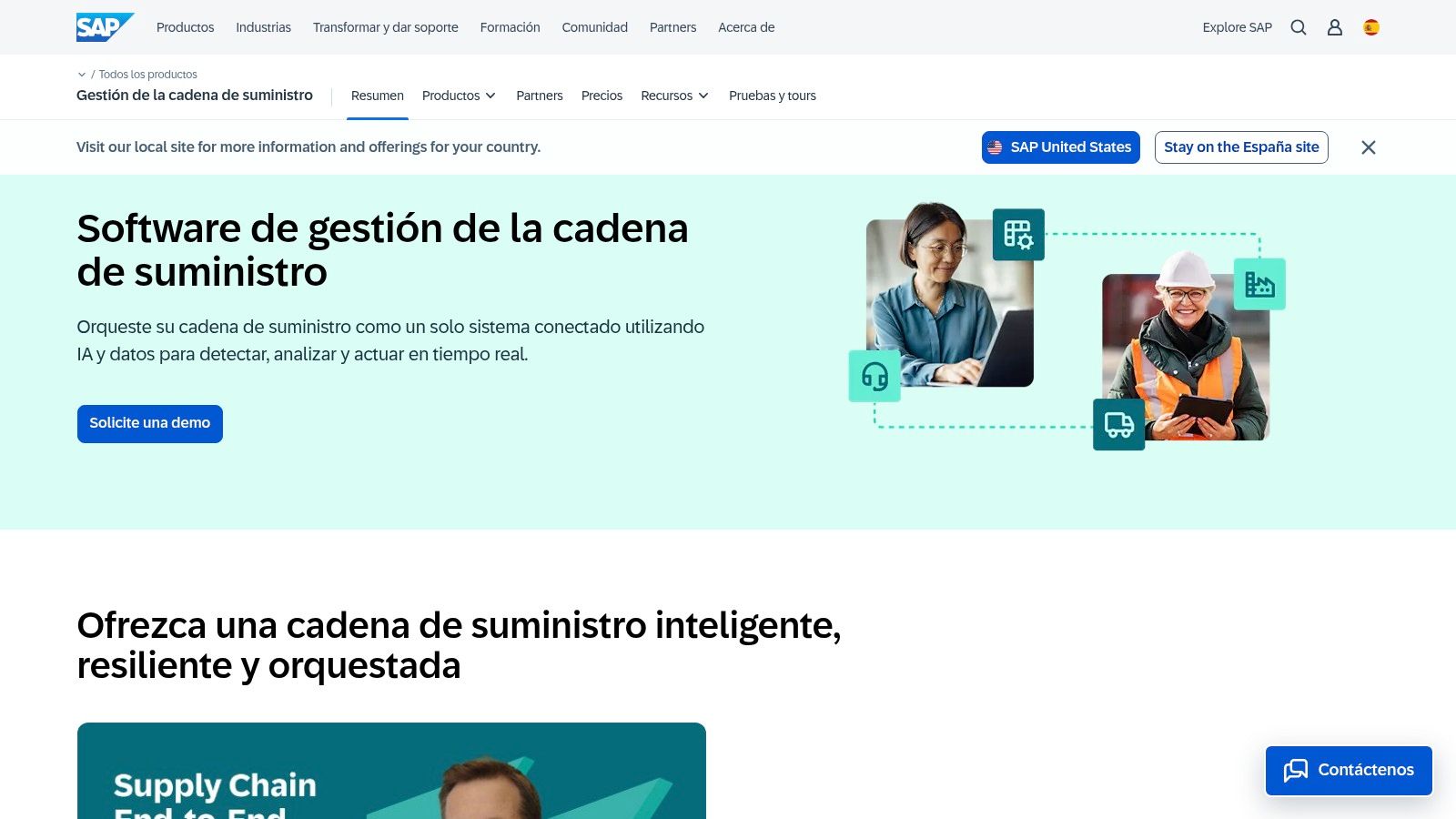
Its SAP Integrated Business Planning (IBP) module leverages AI and advanced analytics for sophisticated demand forecasting and what-if scenario modelling. For example, a car manufacturer could use IBP to simulate the impact of a microchip shortage from a specific supplier, modelling different production schedules and logistics routes to minimise disruption. For manufacturers preparing for regulations, SAP provides robust traceability and quality management features essential for documenting component lifecycles and managing updates, which is vital for fulfilling CRA manufacturer obligations. With a strong presence in Spain, EU-based hosting options, and a mature partner network, it’s a proven choice for regulated industries. However, its complexity and higher total cost of ownership (TCO) make it less suitable for SMEs, who may find the implementation timeline extensive. Pricing is customised and requires direct consultation with SAP or one of its partners.
Website: SAP SCM
3. Oracle Fusion Cloud SCM
Oracle Fusion Cloud SCM offers a unified, cloud-native suite of supply chain software that integrates planning, manufacturing, logistics, and procurement. It is designed for organisations seeking a comprehensive, single-vendor solution that connects supply chain processes with finance and HR in one platform. This integration provides a holistic view of the business, enabling more agile decision-making from demand planning to order fulfilment and financial reconciliation.
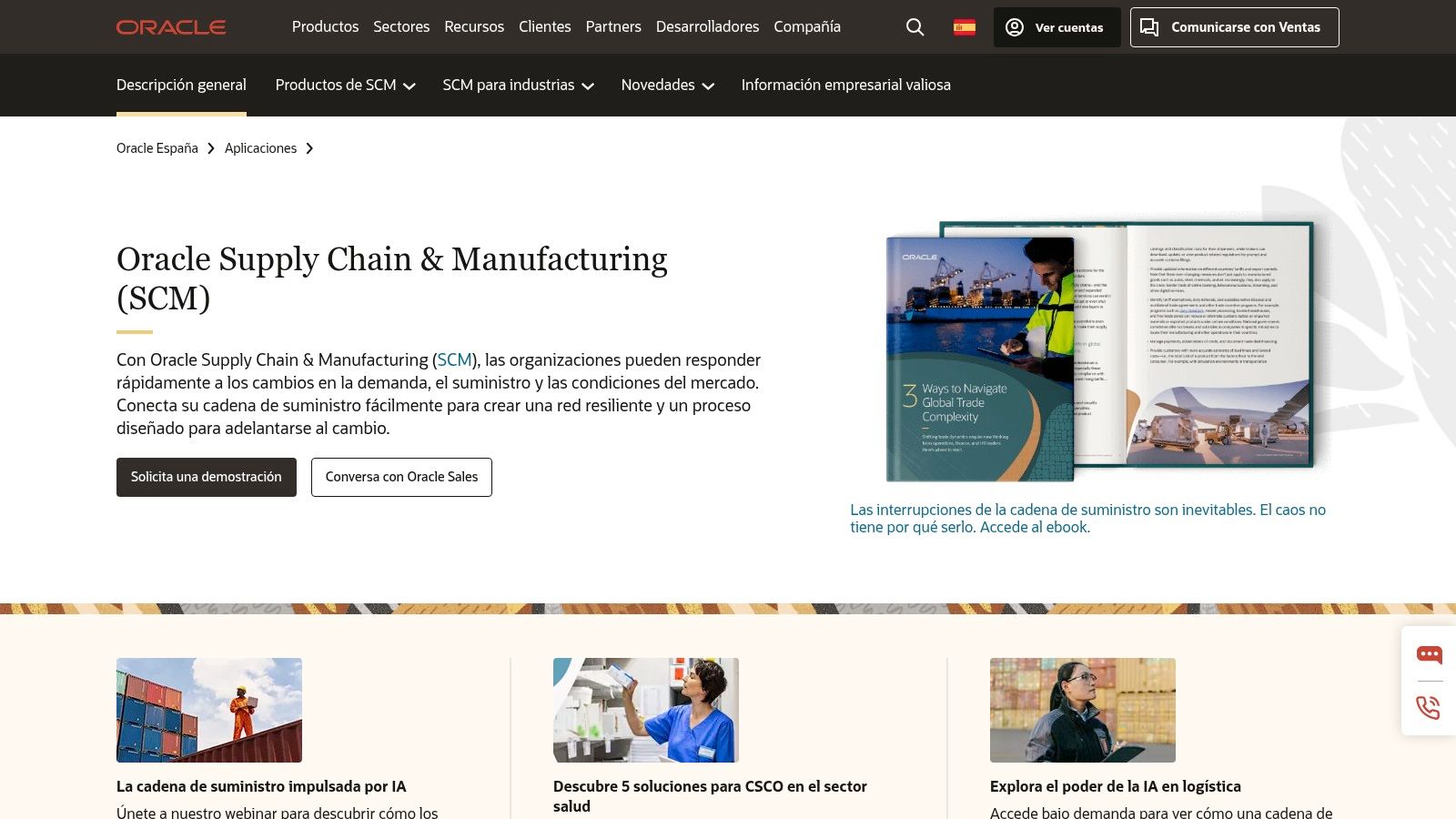
The platform receives quarterly updates, ensuring users have access to the latest features and a strong product roadmap. A practical example is a medical device company using Oracle SCM to manage lot traceability for a critical component. If a defect is found, they can instantly identify which finished products contain that specific lot and where they were shipped, streamlining recall management. Its extensive product documentation is particularly useful for manufacturers documenting their supply chain for compliance, such as for the CRA’s SBOM requirements. With a localised Spanish site and global data centre options, it’s well-suited for EU deployments. While its robust capabilities in order orchestration and logistics are a significant advantage for large enterprises, this enterprise focus may make it oversized for some mid-market companies. Pricing is customised and requires direct engagement with Oracle’s sales team.
Website: Oracle SCM
4. Microsoft Dynamics 365 Supply Chain Management
Microsoft Dynamics 365 offers a modern, cloud-native suite of supply chain softwares that integrates planning, procurement, manufacturing, and warehouse management. Built on the Azure cloud, it excels at connecting disparate operations and data sources, leveraging a familiar Microsoft interface that can reduce user training time. The platform is designed for agility, allowing businesses to scale operations and adapt to market changes with relative ease.
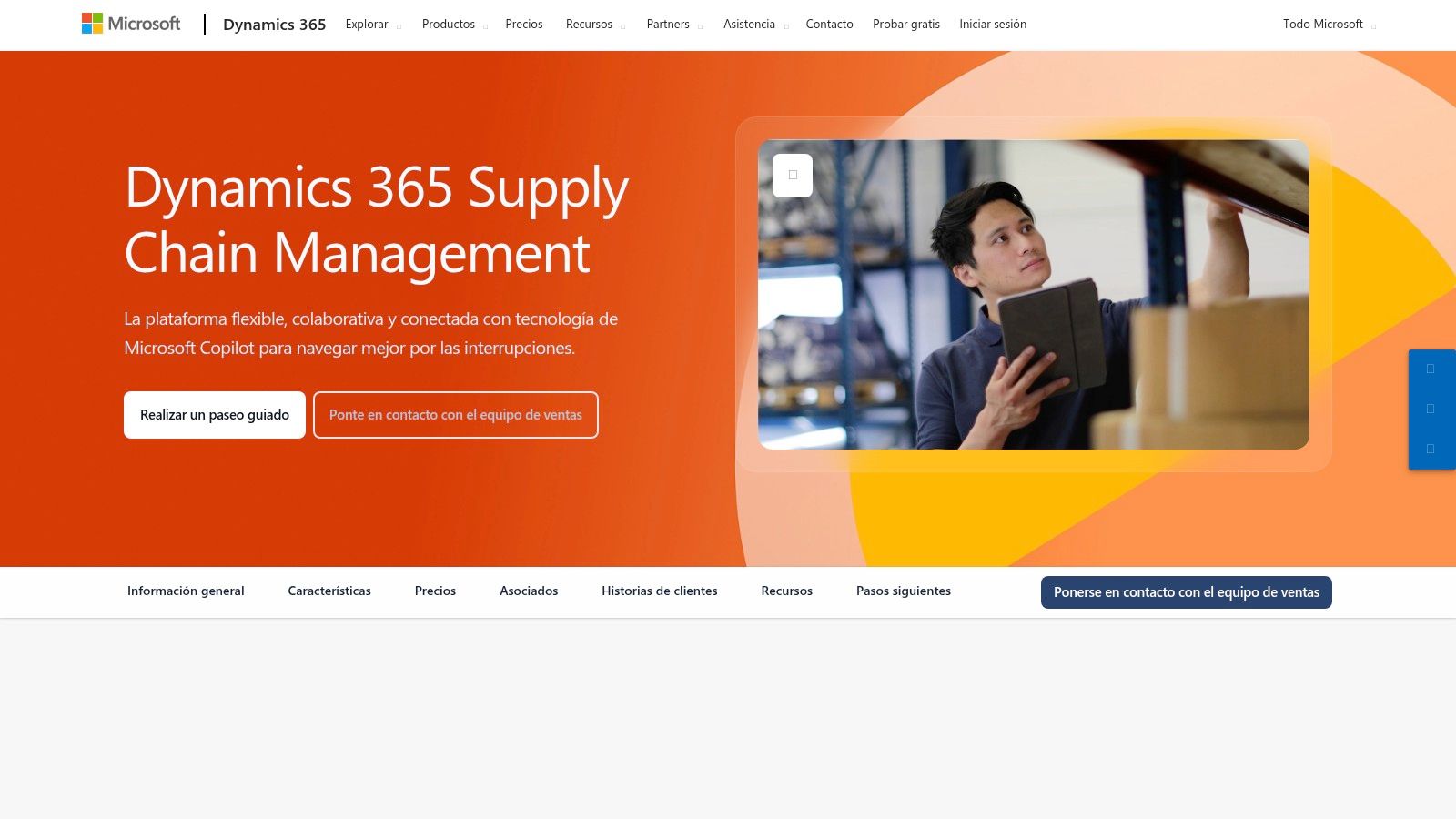
Its key differentiator is the tight integration with the broader Microsoft ecosystem, including Teams, Power Platform, and Azure IoT. This allows for powerful automations; for example, a production line sensor (Azure IoT) could detect an abnormal temperature, automatically create a maintenance work order in Dynamics 365, and notify the floor manager via Teams. For manufacturers focused on compliance, this integration simplifies the evidence-gathering required by a Cyber Resilience Act compliance roadmap. The platform’s use of AI via Copilot assists with demand forecasting and process optimisation. With published pricing for Spain and flexible licensing tiers, it offers more transparent entry points than traditional ERP systems, although its full potential is best realised when a company is already invested in the Microsoft technology stack.
Website: Microsoft Dynamics 365 Supply Chain Management
5. IBM Sterling Order & Fulfillment + Supply Chain Intelligence
IBM offers a powerful combination of its long-standing Sterling Order Management System (OMS) with its modern Supply Chain Intelligence suite. This pairing is engineered for enterprise-level omnichannel retail and distribution, focusing on providing end-to-end visibility and intelligent orchestration. The platform excels at managing complex order and fulfilment logic, from online purchase to final delivery or in-store collection, making it one of the more specialised supply chain softwares for customer-facing operations.
The Supply Chain Intelligence add-on leverages generative AI and machine learning to proactively identify risks, such as potential stockouts or delivery delays, and suggest optimal resolutions. For instance, if a weather event is predicted to disrupt a major shipping lane, the system can automatically suggest re-routing inventory through an alternative port to meet delivery promises. For manufacturers, its robust order and inventory tracking can help document the distribution chain of products containing specific software builds. The primary drawbacks are its enterprise-centric pricing, which is undisclosed, and the fact that broader demand planning may require integration with external tools. It has proven use cases in Spanish-speaking markets and offers strong global support.
Website: IBM Sterling Order Fulfillment Suite
6. Blue Yonder (Luminate Platform)
Blue Yonder’s Luminate platform is a cloud-native solution that leverages artificial intelligence and machine learning for predictive and prescriptive supply chain insights. It excels in unifying planning, logistics, and commerce execution, making it a powerful choice for retailers, consumer packaged goods (CPG) companies, and third-party logistics (3PL) providers. The platform’s strength lies in its cognitive solutions, which automate complex decisions across warehouse management (WMS), transport management (TMS), and order management (OMS).
Its AI/ML-driven forecasting provides a significant advantage for demand planning, allowing businesses to anticipate shifts and optimise inventory levels proactively. A practical example is a CPG company using Luminate to analyze social media trends and point-of-sale data to predict a surge in demand for a specific product, automatically adjusting production and replenishment plans to avoid stockouts. For companies managing complex logistics, the interoperable nature of its WMS and TMS modules ensures seamless data flow from the warehouse floor to final delivery. With established support and content available for the Spanish market, Blue Yonder is a strong contender for enterprise-scale operations in the region. However, its implementation model typically involves certified partners and a significant investment, making it best suited for large organisations rather than SMEs. Pricing is customised and available via a direct quote.
Website: Blue Yonder
7. Kinaxis (Maestro / RapidResponse)
Kinaxis offers a unique approach to supply chain management centred on its concurrent planning technology, enabling all functions to work from a single, synchronised model. Its RapidResponse platform is renowned for its ability to run complex what-if scenarios in real-time, allowing planners to see the end-to-end impact of decisions instantly. This makes it one of the most agile supply chain softwares for organisations facing high demand volatility and frequent disruptions.
Unlike traditional sequential planning tools, Kinaxis provides a holistic view, letting a user model a component shortage and immediately see its effect on production, logistics, and financial forecasts. This capability is invaluable for managing supply chain vulnerabilities and planning for contingencies. For instance, an electronics manufacturer can simulate the impact of a firmware update delay from a key supplier, assessing alternative sourcing options, impacts on production schedules, and profitability within minutes—all in one environment. While it excels at planning, execution functions often require integration with ERP or MES systems. Its strong support organisation and focus on accelerating time-to-value make it a leader for large, global enterprises. Pricing is customised and available through enterprise sales consultation.
Website: Kinaxis
8. o9 Solutions – Digital Brain Platform
o9 Solutions presents its ‘Digital Brain’, an AI-powered platform designed for enterprise-level integrated business planning (IBP) and decision-making. It excels at unifying vast data sets from disparate sources, creating a single source of truth for demand, supply, and financial planning. The platform is engineered to coexist with and enhance incumbent ERP systems, rather than requiring a complete replacement, which can accelerate its return on investment.
Its core strength lies in applying AI and machine learning to complex forecasting and scenario modelling, allowing organisations to run simulations and make more informed strategic choices. A practical case would be a fashion retailer using o9 to model the financial impact of shifting production from one region to another due to changing tariffs, factoring in material costs, labor, and logistics to determine the most profitable course of action. With a strong European presence, including in Spain, o9 provides local expertise, making it a viable option for EU-based businesses looking for advanced supply chain softwares. The platform’s configurability is a key advantage for rapid implementation. However, pricing is geared towards large enterprises and requires a detailed discovery and scoping process. Risk-averse buyers may also want to note an ongoing legal dispute as a potential consideration in their due diligence.
Website: o9 Solutions
9. Infor Supply Chain (including Infor Nexus)
Infor provides a powerful suite of supply chain softwares that excels in execution and multi-enterprise visibility. Its standout offering, Infor Nexus, operates as a networked control tower, giving businesses a unified, real-time view of orders, shipments, and inventory across partners, suppliers, and logistics providers. This is particularly valuable for complex, global supply chains where tracking components and finished goods is a significant challenge. The platform combines this visibility with strong warehouse and transport management systems.
Infor’s Cloud WMS is widely used in Europe and features advanced tools like 3D warehouse visualisation and labour management to optimise fulfilment operations. For example, a global furniture retailer could use Infor Nexus to track a container from a factory in Asia to a distribution center in Europe, receiving real-time updates on its location and customs clearance status. For manufacturers, its predictive alerts and industry-specific solutions help manage disruptions and document the supply chain journey, supporting compliance and traceability requirements. However, Infor is aimed at the enterprise market, meaning implementations can be partner-heavy, and careful module selection is crucial to control costs and complexity. Pricing is customised and available only upon request through their enterprise sales process.
Website: Infor SCM
10. Manhattan Associates – Manhattan Active
Manhattan Associates offers a specialised, execution-focused suite of supply chain software through its cloud-native Manhattan Active platform. It excels in Warehouse Management (WMS), Transportation Management (TMS), and Order Management (OMS), making it a powerhouse for companies with high-volume, complex fulfillment and distribution operations. Its strength lies in optimising the physical movement of goods, from intricate warehouse labour scheduling to efficient parcel and omnichannel fulfillment, rather than broad strategic planning.
The platform’s cloud-native architecture ensures it is always up-to-date without major version upgrades, a key benefit for maintaining operational continuity. For businesses with a strong retail or e-commerce presence, its omnichannel and store-fulfillment capabilities are market-leading. For instance, a retailer can use Manhattan Active OMS to fulfill an online order from the store with the most available inventory that is also closest to the customer, reducing shipping costs and delivery time. With a dedicated sales and support presence in Spain, it provides localised expertise for EU-based enterprises. However, its deep focus on execution means that advanced demand planning or S&OP functionalities typically require integration with other specialised software. Procurement is handled directly through RFP processes and its partner network, with pricing tailored to enterprise-scale deployments.
Website: Manhattan Associates
11. Capterra España – Supply Chain Management category
Capterra España serves as a vital discovery and comparison platform rather than a direct software provider. It offers a localised marketplace where businesses can filter, compare, and read user reviews of a wide array of supply chain softwares. The platform is especially useful for small to medium-sized enterprises (SMEs) looking to navigate the crowded market. Its strength lies in aggregating vendors, allowing users to efficiently shortlist potential solutions based on specific needs like transportation management, inventory control, or Sales and Operations Planning (S&OP).
For a manufacturer assessing tools, Capterra provides a practical starting point. For example, a food and beverage distributor needing better component traceability can filter for tools with strong lot tracking and expiration date management features, and then compare user feedback on their effectiveness and ease of use in a real-world setting. While it’s free to use, remember that not all listings display full or current pricing, and the platform’s focus tends to favour mid-market solutions over complex, large-scale enterprise suites. It excels at facilitating the initial research phase of selecting a new supply chain management tool.
Website: Capterra España SCM
12. SoftDoit (SoftwareDoit.es) – Spain SCM directory
SoftDoit is a Spain-centric software comparator and advisory service, rather than a single software product. It acts as a specialised directory, helping businesses in Spain identify and connect with suitable SCM vendors and local implementation partners. The platform simplifies the initial discovery phase by organising supply chain softwares into sector-specific categories, such as logistics, manufacturing, or fashion, allowing users to quickly narrow their search. Its primary function is to facilitate connections by enabling users to request quotes and demos from multiple relevant providers through a unified process.
The platform stands out for its localised focus, providing insights into which solutions and integrators have a strong presence and track record within the Spanish market. For a practical example, a manufacturer of industrial machinery in Catalonia looking to document its component sources for compliance could use SoftDoit to identify local vendors and implementation partners whose systems are already aligned with regional business practices and regulations. While the service is free for buyers, its model means that content and recommendations may favour vendors participating in its lead-generation programme. The user experience is straightforward, guiding users through a needs assessment to match them with potential solutions, though it does not offer direct pricing information.
Website: SoftDoit SCM
Top 12 Supply Chain Software Comparison
| Product | Core focus | Key features | Target audience | Pricing & value |
|---|---|---|---|---|
| Regulus | CRA compliance platform for EU Cyber Resilience Act (applicability → roadmap) | Applicability checker; product classification; requirements matrix; Annex II/VII templates; vulnerability management | Manufacturers, IoT vendors, digital product teams placing products with digital elements in EU | Transparent tiers: Basic €1,500; Pro €5,500/yr; Enterprise custom. Early Access 20% off; lowers consulting cost |
| SAP – Supply Chain Management (SCM) & IBP | End‑to‑end SCM + Integrated Business Planning | Planning, EWM/TM, PLM, EAM; IBP with AI analytics; SAP HANA for scenario modelling | Large manufacturers, regulated industries, enterprise IT landscapes | Quote-based; typically higher TCO; strong partner ecosystem and EU hosting options |
| Oracle Fusion Cloud SCM | Unified cloud supply chain suite | Integrated planning, WMS, TMS, order mgmt, procurement; quarterly updates; global DC footprint | Enterprises seeking single‑vendor cloud SCM | Quote-based enterprise pricing; localized Spanish site |
| Microsoft Dynamics 365 Supply Chain Management | Cloud SCM integrated with Microsoft ecosystem | Planning, procurement, WMS, asset mgmt; AI/Copilot; Azure/Teams/Power Platform integration | Organisations using Microsoft stack; mid-to-large enterprises | Published Spain pricing tiers; flexible licensing options |
| IBM Sterling Order & Fulfillment + Supply Chain Intelligence | Enterprise order, fulfillment and supply chain intelligence | OMS for omnichannel; AI/ML risk detection; add‑ons for resilience and engagement | Omnichannel retail, distribution enterprises | Enterprise sales model; pricing on request |
| Blue Yonder (Luminate) | AI‑driven planning and execution for retail/CPG | AI/ML planning, WMS/TMS/OMS, cognitive agents; strong logistics depth | Retailers, CPG, logistics providers, 3PLs | Quote-based; partner-led enterprise implementations |
| Kinaxis (RapidResponse / Maestro) | Real‑time concurrent planning and scenario modelling | Fast scenario analysis; single planning platform; rapid time‑to‑insight | Planning teams at global manufacturers seeking fast ROI | Enterprise pricing via sales; quote-based |
| o9 Solutions – Digital Brain | AI‑powered unified planning & decision intelligence | IBP, demand/supply planning, AI agents, ERP co‑existence, mobile app | Enterprises needing advanced IBP and decision intelligence | Enterprise pricing; requires scoping; noted legal dispute (risk consideration) |
| Infor Supply Chain (incl. Infor Nexus) | SCM planning/execution + multi‑enterprise visibility | Nexus control tower, cloud WMS, real‑time visibility, predictive alerts | Firms needing network visibility and warehouse execution | Quote-based; partner-heavy implementations |
| Manhattan Associates – Manhattan Active | Cloud‑native execution: WMS, TMS, OMS | Continuous updates, deep labor & fulfillment optimisation, omnichannel capabilities | High‑volume warehouses, omnichannel retailers, 3PLs | RFP/partner procurement; enterprise pricing |
| Capterra España – SCM category | Marketplace and reviews for SCM software | Spain category filters, user reviews, feature matrices, vendor links | Buyers shortlisting SCM tools in Spain | Free to use; indicative pricing on some listings |
| SoftDoit (SoftwareDoit.es) – Spain SCM directory | Spain‑centric vendor directory and lead generation | Localized vendor listings, sector pages, quote/demo requests, integrator highlights | Spanish buyers seeking vendors and local implementers | Free discovery; vendor-provided quotes and contact matchmaking |
Choosing Your Path to a Resilient and Compliant Supply Chain
Navigating the landscape of supply chain softwares can feel overwhelming, but as we’ve explored, the right technology is no longer a luxury, it’s a strategic necessity. The journey from sourcing raw components to delivering a finished, secure product to the end user is a complex web of dependencies. Each link in that chain presents a potential risk, not just to your operations but to your regulatory standing, especially with directives like the EU’s Cyber Resilience Act (CRA) redefining the standards for market access.
The tools detailed in this guide, from comprehensive ERP modules like SAP SCM and Oracle Fusion Cloud SCM to specialised platforms such as Regulus, represent a fundamental shift. They move supply chain management from a purely logistical function to a core component of your product security and compliance strategy. The key takeaway is that visibility is the foundation of resilience and conformity.
From Theory to Practice: Selecting Your Software
Your choice of software should be a direct reflection of your organisation’s unique challenges and strategic goals. A large-scale automotive manufacturer with complex global logistics might find the extensive planning and execution capabilities of a platform like Kinaxis or Microsoft Dynamics 365 indispensable. For instance, they could use the software to model the financial and production impact of a two-week shipping delay from a battery supplier in Asia, allowing them to proactively adjust assembly line schedules across multiple European plants.
In contrast, a nimble IoT device vendor preparing for CRA obligations might prioritise different features. Their primary concern isn’t necessarily global logistics optimisation but rather achieving deep visibility into their software bill of materials (SBOM) and managing component vulnerabilities. For them, a purpose-built solution like Regulus, which is focused on product security and compliance documentation, offers a more direct and efficient path to meeting regulatory requirements without the overhead of a full-scale SCM suite.
Key Considerations for Implementation
Before committing to a solution, it’s crucial to map out your implementation strategy. Consider the following actionable steps:
- Define Your Primary Objective: Is your main goal operational efficiency, cost reduction, or achieving demonstrable CRA compliance? Be specific. For example, your objective could be “to reduce inventory carrying costs by 15% by improving demand forecast accuracy” or “to automate the generation and maintenance of SBOMs for all products sold in the EU”.
- Assess Integration Needs: Evaluate how a new system will connect with your existing tools, such as your Product Lifecycle Management (PLM) or enterprise resource planning (ERP) systems. Poor integration can create data silos, defeating the purpose of enhanced visibility. A practical test would be ensuring that a component change in your PLM automatically updates the bill of materials in your SCM software.
- Involve Cross-Functional Teams: Your compliance, legal, engineering, and procurement teams must be part of the selection process. Their diverse perspectives ensure the chosen software addresses the full spectrum of business needs, from technical vulnerability tracking to legal evidence provision.
Ultimately, the most effective supply chain softwares are those that are not only powerful but also well-aligned with your operational realities and compliance roadmap. The goal is to build a technology stack that transforms your supply chain from a potential liability into a fortified, transparent, and competitive asset, securing your place in the European market for years to come.
Ready to streamline your compliance efforts and gain complete visibility into your product’s software supply chain? Regulus provides a purpose-built platform to automate SBOM generation, manage vulnerabilities, and generate the technical documentation required for the CRA. Discover how Regulus can simplify your path to compliance and secure your market access.