When you hear the term product lifecycle manager, it’s easy to get confused. Are we talking about a person or a piece of software? The answer is both. The term refers to two distinct but deeply connected concepts: a strategic professional role and a powerful software tool.
Both are absolutely essential for steering a product from a simple idea all the way through development, market launch, and its eventual retirement.
Unpacking The Product Lifecycle Manager: Role vs. Tool

To really get a grip on this, it helps to separate the person from the platform.
Think of the human manager as a film director. Their job is to orchestrate the entire production, making sure every department—from design (the scriptwriters) to engineering (special effects) and marketing—works in perfect harmony to deliver a blockbuster hit.
The Product Lifecycle Management (PLM) software, then, is the studio. It provides the director with the tools, infrastructure, and centralised data needed to manage the entire complex process. For example, the PLM software would be the system holding the master blueprint for a new car model, accessible by design, engineering, and supply chain teams simultaneously. The director has the vision; the studio provides the means to execute it.
A Tale of Two Lifecycles
Understanding this distinction is crucial in today’s market. A product lifecycle manager (the person) is focused on the high-level strategy, market analysis, and coordinating all the different teams. They’re the ones making the critical calls that define a product’s journey.
For example, when a smart thermostat company plans a new model, the manager decides which features to include (like learning algorithms for energy savings) based on competitive analysis and customer surveys. They set the launch timeline and make sure engineering, marketing, and sales are all aligned for a smooth rollout.
In contrast, the Product Lifecycle Management tool is the operational backbone. This software suite becomes the single source of truth for every bit of product-related data. It manages everything from the initial design files and bills of materials (BOMs) to change orders and supplier information. A practical example would be an aerospace company using PLM software to track every single component of a jet engine, from the initial CAD drawings to supplier certifications and maintenance records.
Here’s a simple breakdown to clarify the differences.
Product Lifecycle Manager at a Glance: Role vs. Tool
| Aspect | The Role (Human Manager) | The Tool (PLM Software) |
|---|---|---|
| Primary Focus | Strategy, vision, and market success | Data management, process automation, and collaboration |
| Key Activities | Market research, defining product roadmaps, cross-functional team leadership | Managing CAD files, BOMs, change orders, and supplier data |
| Core Goal | Deliver a successful product that meets customer needs and business goals | Provide a single source of truth for all product information |
| Analogy | The Film Director | The Film Studio |
In short, the manager defines the “why” and “when,” while the software provides the “how” and “where” for all the product data and processes. This synergy is fundamental for effective product development.
Navigating Modern Complexity
The importance of having both a skilled manager and a robust tool has skyrocketed with the rise of complex regulations. New rules like the EU’s Cyber Resilience Act (CRA) impose strict obligations on manufacturers of any product with digital components.
These regulations demand meticulous tracking of every part, managing security updates, and keeping detailed documentation throughout the product’s entire life.
This is where the combination of a sharp product lifecycle manager and a powerful PLM system becomes indispensable. For an IoT camera vendor, it’s no longer enough to just design a great product. They now have to track every single software component to manage vulnerabilities and deploy security patches—tasks that are virtually impossible without a dedicated system. For example, if a vulnerability is discovered in a common open-source library used in their camera’s firmware, the PLM system can instantly identify every product model affected, enabling a rapid and targeted response.
To learn more about the software that underpins these operations, explore our resources on supply chain softwares. Meeting these new requirements isn’t optional anymore; it’s a prerequisite for even getting your product on the market.
Core Responsibilities and How Success Is Measured
A product lifecycle manager is much more than a job title. Think of them as the strategic hub for a product, the central point connecting diverse teams and guiding a product from a flicker of an idea all the way to its eventual phase-out. Their daily work is a constant blend of high-level strategy, deep market analysis, and hands-on coordination.
This role demands a rare ability to see both the forest and the trees. One minute they’re analysing market trends to predict a product’s future; the next, they’re huddled with engineers to solve a critical production snag. For example, they might spend the morning reviewing a market report on competitor pricing, then spend the afternoon in a meeting to resolve a supply chain issue with a key component manufacturer.
The Strategic Coordinator
At its heart, the role is about orchestration. The product lifecycle manager ensures that every team—from engineering and marketing to sales and support—is perfectly aligned and pulling in the same direction. They are the translator, turning technical jargon into compelling marketing points and channeling customer feedback back to the developers who can act on it.
Here’s a practical example: Imagine a company is launching a new smart home security camera. The product lifecycle manager is the one making sure all the pieces fit together:
- They confirm with Engineering that the final firmware is stable and meets all security standards.
- They work with Marketing to ensure the launch campaign highlights the camera’s unique encryption features.
- They equip the Sales team with the technical details needed to answer customer questions with confidence.
- They prepare the Support team with troubleshooting guides for the most common setup issues.
This kind of coordination breaks down silos and is the secret to a smooth, unified product launch.
Measuring Success with Key Performance Indicators
Success for a product lifecycle manager isn’t just about getting a product out the door. It’s about launching it efficiently, profitably, and in full compliance with all regulations. Their performance is tracked against tangible Key Performance Indicators (KPIs) that tell the story of the product’s health and market performance.
A great product lifecycle manager doesn’t just manage processes; they drive outcomes. Their success is directly tied to the product’s profitability, market adoption, and long-term viability.
Some of the most critical KPIs include:
- Time-to-Market (TTM): This is all about speed—how quickly can you get from concept to a product in the customer’s hands? A shorter TTM means you can seize market opportunities before the competition. For example, reducing TTM for a new smartphone model by three months could mean launching before a key competitor, capturing critical holiday season sales.
- Cost of Goods Sold (COGS): This KPI tracks the direct costs of actually producing the product. The manager is always looking for ways to optimise the supply chain and manufacturing to keep COGS low and profit margins healthy. An example would be renegotiating a contract with a chip supplier to lower the cost per unit, directly improving the product’s profitability.
- Compliance Adherence Rate: In today’s regulatory climate, this is non-negotiable. It measures how well the product meets every single legal and industry standard, from safety certifications to complex cybersecurity mandates. A practical measure of this is having zero product recalls or market access denials due to non-compliance in a given year.
Compliance as a Core Responsibility
As product development gets more complex, compliance has become a central pillar of the product lifecycle manager’s role. This is especially true for companies selling into the EU. The European market for Product Lifecycle Management (PLM) is valued at $12.0 billion in 2024 and is projected to hit $23.5 billion by 2035, a surge driven largely by intricate new regulations. With over 75% of EU manufacturers now building IoT into their products, the need for robust management is critical.
A perfect example is navigating the EU’s Cyber Resilience Act (CRA). The product lifecycle manager is on the hook for ensuring a product meets these tough cybersecurity requirements. This means managing everything from vulnerability disclosure workflows, where security researchers report potential issues, to making sure security patches are developed and deployed on time. For instance, this involves setting up a public-facing email address (e.g., security@company.com) and ensuring all reports are acknowledged and tracked internally.
This duty is directly linked to the compliance adherence KPI. Successfully managing these workflows proves the company is meeting its obligations. For anyone making IoT devices, understanding the specific CRA manufacturer obligations is the essential first step. By building compliance into the product journey from day one, the product lifecycle manager de-risks the entire process, protecting both the customer and the company.
Navigating Each Stage of the Product Lifecycle
A product’s journey is rarely a straight line; it’s a dynamic arc with distinct stages, much like captaining a ship through changing seas. For a product lifecycle manager, guiding that product requires a different strategy for each phase—Introduction, Growth, Maturity, and Decline. Each one demands a unique set of actions and a keen eye on the horizon.
Knowing how to manage these transitions is what separates market leaders from forgotten failures. It’s all about timing—when to invest, when to pivot, and when to plan for a graceful exit. This strategic oversight ensures a product doesn’t just launch successfully but stays relevant and profitable for as long as possible.
The Introduction Stage: Seizing the Opportunity
The introduction stage is where you make your first impression, and it has to be a strong one. After months, or even years, of hard work, the product finally hits the market. The product lifecycle manager’s entire focus shifts to building initial awareness and carving out a market position.
This is a time of high investment and, often, low initial sales as the market gets to know what you’ve built. The manager becomes the central coordinator, working with marketing on targeted campaigns and with sales to land those critical first customers.
Practical Example: Imagine a company is launching a new line of smart, connected home locks. The product lifecycle manager’s immediate priorities would be:
- Positioning: Deciding whether to market the lock as a premium security device or an affordable convenience gadget. This choice shapes everything that follows, from the packaging design to the online ad copy.
- Initial Compliance: Making sure all launch materials and product documentation meet regional rules, like CE marking in the EU, from day one. This includes ensuring the CE mark is physically present on the product and packaging.
- Feedback Collection: Setting up channels to gather early user feedback, such as an in-app survey or a dedicated forum, to find and squash bugs or usability issues fast.
This groundwork is absolutely fundamental. A misstep here, like failing an initial compliance check, can derail the launch and hand a huge advantage to competitors.
The Growth Stage: Scaling Up
Once the product gains traction and sales start to climb, it enters the growth stage. This is when the business begins to see real profitability. The product lifecycle manager’s role evolves from establishing a foothold to scaling operations and defending market share against new competitors who are inevitably drawn in by the product’s success.
The focus moves to expanding distribution channels, adding new features based on that early feedback, and optimising the supply chain to meet rising demand. A practical example here is a manager for a popular fitness tracker deciding to add a new “sleep tracking” feature in response to customer requests, while simultaneously negotiating a deal to sell the tracker in a major retail electronics chain. It’s a delicate balancing act of aggressive expansion while keeping a firm grip on quality and support.
During the growth phase, the product lifecycle manager must act as both an innovator and a guardian. They have to push for new features that excite the market while simultaneously reinforcing the core value proposition that brought initial success.
The Maturity Stage: Optimisation and Defence
The maturity stage is often the longest and most profitable part of the journey. Sales growth slows as the market becomes saturated. The product lifecycle manager’s main goal here is to defend market share and maximise profit. The strategy pivots from rapid expansion to efficiency and retention.
This is where ongoing compliance and security management become non-negotiable. For any product with digital elements, regulatory demands like the EU’s Cyber Resilience Act (CRA) require constant vigilance. The manager must oversee a structured process for releasing security patches and managing vulnerabilities throughout the product’s supported life.
This isn’t just about technical fixes; it’s a core part of maintaining customer trust and market access. For instance, managing a security update for an IoT device involves a clear, repeatable workflow:
- Vulnerability Detection: Actively monitoring for new threats and receiving reports through a coordinated disclosure policy. A practical example is a security researcher privately reporting a flaw in the device’s web interface.
- Patch Development: Coordinating with engineering to develop, test, and validate a security patch. This involves creating a specific task in a project management tool like Jira and tracking its progress.
- Secure Deployment: Releasing the update to all users in a timely and secure manner, often via an over-the-air (OTA) update.
- Documentation: Recording every action taken—from the initial report to the final deployment—to provide solid evidence of compliance for any regulatory audits.
Managing this complex process effectively requires a structured approach. You can learn more about building this capability by reading our guide on the CRA Secure Development Lifecycle (SDL), an essential framework for this stage.
The Decline Stage: The Final Chapter
Eventually, every product enters the decline stage. Sales begin to fall, whether due to market saturation, changing consumer tastes, or new technology making the product obsolete. The product lifecycle manager has to make a difficult but crucial decision: how to manage the product’s end of life.
The options range from phasing it out gradually, selling the product line to another company, or discontinuing it altogether. The manager’s job is to execute this final stage in a way that minimises financial loss while preserving a positive brand reputation. For example, when a software company sunsets an old version of their application, the manager would orchestrate a communication plan that gives users six months’ notice, offers a discount on the new version, and provides clear instructions for data migration. This clear, honest communication is vital for a smooth transition.
Building a Workflow for EU Cyber Resilience Act Compliance
If you’re a product lifecycle manager with products heading to the European Union, the Cyber Resilience Act (CRA) is about to become a very big deal. It’s a fundamental shift, moving cybersecurity from a feature you might add to a legal requirement you can’t ignore. This means building a structured, repeatable workflow isn’t just good practice anymore—it’s your ticket to market access.
Trying to tackle this with a patchwork of spreadsheets and disconnected documents is a recipe for disaster. A modern workflow, on the other hand, breaks the entire compliance journey into clear, manageable stages. It transforms what looks like a massive regulatory mountain into a series of achievable steps, ensuring nothing gets missed from the first assessment to ongoing support.
The following diagram shows the classic product journey, and a solid compliance workflow needs to support every single stage.
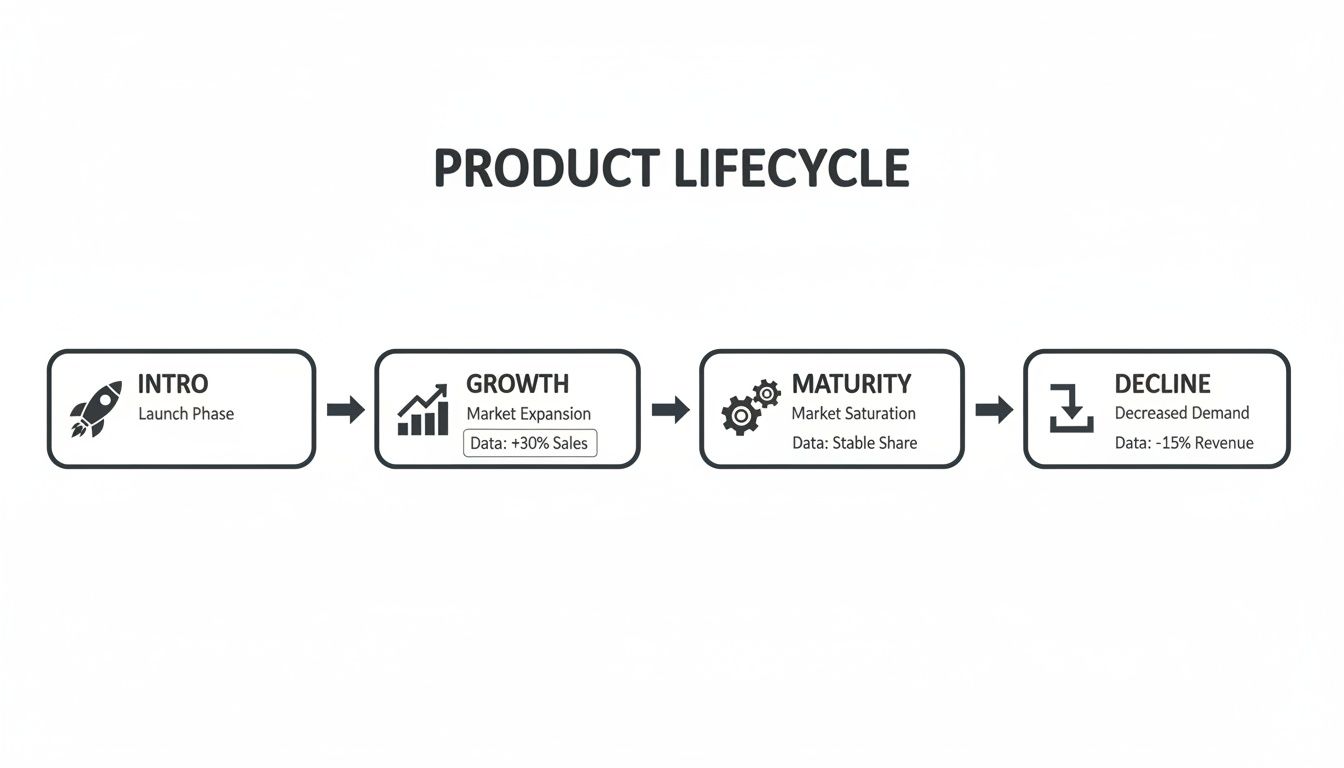
This lifecycle view makes it clear: compliance isn’t a one-and-done task at launch. It’s a continuous responsibility.
Step 1: Conduct an Applicability Assessment
First things first: does the CRA even apply to your product? This has to be your starting point. The regulation targets products with digital elements, which is a deliberately broad term covering everything from smart thermostats and industrial controllers to standalone software like a mobile app. As the product lifecycle manager, you need to lead this initial investigation.
The key question is simple: Is your product designed to connect to another device or a network, directly or indirectly? For example, if you manufacture a Bluetooth-enabled coffee maker that connects to a smartphone app, the answer is yes. If you make a purely mechanical coffee press, the answer is no. This assessment can’t just be a casual chat; it needs to be formally documented because it’s the foundation of your entire compliance strategy.
Step 2: Classify Your Product
Once you’ve confirmed the CRA is in scope, the next job is to classify your product. The regulation splits products into two main buckets, each with its own level of scrutiny and set of obligations.
- Default (Unclassified): The majority of products will land here. They need to meet the essential security requirements laid out in Annex I of the act but can generally get by with a self-assessment for conformity. A practical example is a connected children’s toy with basic Bluetooth features.
- Critical: These are products considered to pose a higher cybersecurity risk. They’re broken down further into Class I and Class II and demand much tougher conformity assessments, often requiring a third-party notified body to sign off.
Let’s take a practical example. A company building a smart security camera with remote access, or a network firewall for business use, would almost certainly see their product classified as ‘Critical’. That decision immediately sets off a far more demanding chain of compliance tasks than if they were building, say, a simple connected toaster.
Step 3: Map Requirements to Product Features
With the classification sorted, the workflow gets down to the nitty-gritty: mapping the specific CRA rules to your product’s features and development processes. This is where dense legal text gets translated into concrete tasks for your engineering and documentation teams. A platform like Regulus is built for this, turning confusing legal articles into a straightforward checklist.
For our ‘Critical’ smart camera, this means translating Annex I requirements into real work. The requirement for “protection from unauthorised access” would map directly to engineering tasks like implementing multi-factor authentication and enforcing strong default passwords from the get-go.
This mapping document becomes the single source of truth for the whole team. It connects the legal obligations to the daily work of developers, security engineers, and technical writers. It also creates a clear path for generating the proof you’ll need for your technical documentation. Having a well-defined Cyber Resilience Act compliance roadmap is absolutely essential here.
Step 4: Manage Ongoing Updates and Vulnerabilities
CRA compliance doesn’t stop once the product is boxed and shipped. The act demands ongoing security support for the product’s expected lifetime or for five years, whichever is shorter. This calls for a bulletproof workflow for managing security updates and handling any reported vulnerabilities.
This is a huge operational responsibility, but it’s also a chance to become more efficient. Germany, which holds the largest share of the PLM market in Western Europe, is a perfect example of this push for regulatory alignment. In a region where 60% of connected devices will need ongoing security updates to meet EU rules, PLM tools can slash maintenance costs by 25-30% by centralising data. For manufacturers facing CRA deadlines, this just goes to show the massive financial and operational upsides of adopting integrated compliance tools.
The product lifecycle manager has to put clear processes in place for taking in vulnerability reports, working with engineering to get patches built, and deploying those updates securely to every user. A practical example is having a documented plan that guarantees a critical vulnerability will be patched and deployed via an over-the-air update within 15 business days of confirmation. This workflow isn’t static; it’s a living process that needs to be carefully maintained, because market authorities can and will audit it long after the product has been sold.
Integrating Essential Tools for Maximum Efficiency
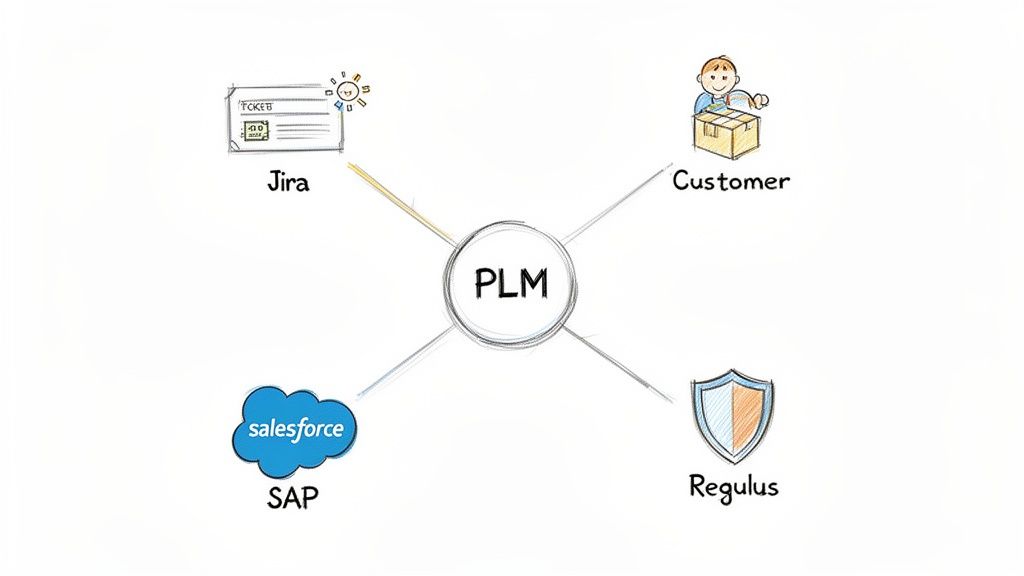
A product lifecycle manager can’t operate in a vacuum. Their real impact comes from orchestrating a connected ecosystem of software, where information flows freely between departments. While a central Product Lifecycle Management (PLM) system acts as the digital spine, its true power is unlocked when you integrate it with other critical business tools. This is how you create a single, coherent view of the product’s entire journey.
Without these connections, teams are left working in silos. Engineering misses out on real-time customer feedback from support, marketing is guessing at production timelines, and compliance becomes a frantic scramble to chase down documents from a dozen different places. A well-integrated toolset tears down these walls, turning scattered data points into genuine, actionable intelligence.
Connecting Project Management Tools
One of the most crucial integrations is with project management software like Jira or Asana. These platforms are where the day-to-day engineering work gets done. By linking a PLM system to Jira, for instance, a product lifecycle manager creates a direct, two-way bridge between high-level product strategy and the tangible engineering tasks needed to bring it to life.
This connection is absolutely vital for regulatory compliance. When a security vulnerability pops up, the response needs to be fast, decisive, and meticulously documented.
Here’s how that plays out:
Imagine a new vulnerability is reported for one of your smart thermostats. That report automatically generates a ticket in Jira. Thanks to the integration, this ticket is instantly linked to the product’s master record in the PLM system. From there, the product lifecycle manager can track the entire fix—from assigning the bug to an engineer, to testing the patch and deploying the update—all from a single, central product record. This creates a perfect, auditable trail, giving you solid evidence for CRA compliance that the incident was managed correctly from start to finish.
Linking CRM and ERP Systems
Next up are the heavy hitters of the business world: Customer Relationship Management (CRM) and Enterprise Resource Planning (ERP) systems. These tools hold the keys to understanding what your customers actually want and managing the realities of your physical supply chain.
- CRM Integration (e.g., Salesforce): This is your direct line to the customer. It pipes in feedback, sales data, and support tickets right into the product development process. It helps the product lifecycle manager make sharp, data-driven decisions on everything from new features to end-of-life planning. A practical example is noticing a sudden spike in Salesforce support tickets about a specific feature malfunctioning after a software update; this data immediately flags a potential issue for the product team to investigate.
- ERP Integration (e.g., SAP): This grounds your product design in the physical reality of manufacturing and inventory. An ERP link ensures that the bill of materials (BOM) in your PLM system is perfectly synchronised with what’s actually happening on the factory floor and in the warehouse. For example, if the ERP system shows a shortage of a specific memory chip, the PLM can flag this to engineers who might need to approve an alternative supplier or component.
Integrating CRM and ERP systems transforms the PLM from a simple engineering database into a dynamic business tool. It bridges the gap between what customers want, what engineers design, and what the business can profitably produce and support.
A well-integrated PLM system becomes the central hub where data from various business functions converges, providing a holistic view of the product lifecycle. The table below summarises some of the most common and valuable integrations.
| Tool Category | Example Software | Primary Function & Benefit |
|---|---|---|
| Project Management | Jira, Asana | Links strategic goals to daily tasks, enabling real-time tracking of development and bug fixes for compliance traceability. |
| CRM | Salesforce, HubSpot | Feeds customer feedback, support issues, and sales data into the product plan, ensuring decisions are market-driven. |
| ERP | SAP, Oracle NetSuite | Synchronises the Bill of Materials (BOM) with manufacturing and inventory, ensuring design aligns with production reality. |
| Regulatory Compliance | Regulus | Maps regulatory requirements (like the CRA) directly into development workflows, automating evidence collection. |
| Source Code Mgmt | GitHub, GitLab | Links code repositories to product versions, providing a clear history of changes and contributions for security audits. |
These integrations aren’t just about convenience; they’re about creating a single source of truth that empowers the product lifecycle manager to make smarter, faster, and more compliant decisions.
Unifying Compliance with Specialised Platforms
Finally, in an era of complex regulations like the Cyber Resilience Act, plugging in a dedicated compliance platform is no longer just a good idea—it’s essential. A PLM system is great at managing product data, but it wasn’t built to interpret and manage ever-changing legal requirements. This is where a specialised tool like Regulus becomes indispensable.
Regulus acts as the single source of truth for all your CRA obligations. It doesn’t just sit on the sidelines; it integrates with your PLM and project management tools to inject compliance requirements directly where the work is happening. Instead of engineers having to guess what “secure by default” actually means in practice, Regulus provides them with a clear, actionable checklist mapped directly from the regulation itself. For instance, the task “Ensure secure by default configuration” in Regulus would link to a specific Jira ticket for the engineering team to implement strong default passwords and disable unnecessary open ports before shipping.
It comes with ready-to-use templates for technical files and streamlines evidence generation. As your teams complete their tasks in Jira and update files in the PLM, they are simultaneously and automatically building the documentation required to prove compliance. This turns a complex, manual headache into a structured, automated, and far less risky workflow. The product lifecycle manager can then oversee this entire process from a central dashboard, confident that compliance is being built in from the start, not bolted on at the end.
Creating Your Actionable Compliance Roadmap
Turning dense regulations like the Cyber Resilience Act (CRA) into a concrete, step-by-step plan can feel like an impossible task. For a product lifecycle manager, this is where the theory hits the road. Your job is to translate legal text into a practical strategy that gives teams clarity, assigns ownership, and makes sure deadlines are actually met. It’s not about ticking boxes; it’s about building a solid, repeatable process to get your products ready for the market.
This is where a dedicated platform like Regulus changes the game, turning a massive headache into a manageable project. The entire process kicks off with a simple but crucial step: generating an applicability report. This initial check gives you a straight “yes” or “no” on whether the CRA applies to your product, cutting through the ambiguity from day one.
Generating a Step-by-Step Plan
Once you’ve confirmed the CRA applies, the system helps you generate a full compliance roadmap. But this isn’t just another checklist. It’s a detailed, phase-by-phase guide built specifically for your product’s classification and your company’s role in the supply chain—whether you’re the manufacturer, an importer, or a distributor.
Let’s say your smart home hub gets classified as a “Critical” product. The roadmap will automatically fill up with the tougher conformity assessment tasks that come with that classification. For example, it will create a specific task: “Engage a Notified Body for third-party assessment,” and provide a template for the required technical documentation you’ll need to submit. It takes huge obligations and breaks them down into small, manageable actions you can assign to your team.
A truly effective roadmap doesn’t just tell you what to do; it gives you the tools to actually do it. By weaving in documentation templates and evidence-generation workflows, it transforms compliance from a vague goal into a series of concrete deliverables.
From Plan to Tangible Outcomes
The real power of this approach is its relentless focus on real-world outcomes. The roadmap comes loaded with ready-to-use templates for essential documents, like the EU Declaration of Conformity and the technical files specified in the CRA Annexes. This alone can save hundreds of hours and dramatically lower the risk of creating non-compliant paperwork.
Here’s what this looks like for a product lifecycle manager overseeing a portfolio of IoT devices:
- Evidence Generation: When your engineering teams finish a security task—for example, implementing encryption for data in transit—they can upload a screenshot of the code or a test report directly into the system, linking it to the specific CRA requirement it fulfils.
- Structured Documentation: Your technical writers can start with pre-built templates for the technical file, ensuring the structure of their documents meets regulatory standards from the very first draft, rather than starting from a blank page.
- Clear Workflows: The roadmap demystifies complex processes like vulnerability disclosure by laying out the exact steps, from creating a “security@company.com” contact point to defining the internal process for assessing and patching reported flaws.
By applying this structured process across your entire product portfolio, you can build a consistent and cost-effective way to achieve and maintain compliance. Suddenly, a daunting regulatory hurdle becomes a predictable, structured, and—most importantly—manageable part of your product lifecycle.
Frequently Asked Questions
Let’s clear up a few common questions about the product lifecycle manager role, the software they use, and how to navigate modern compliance challenges.
What Is the Main Goal of a Product Lifecycle Manager?
The core mission of a product lifecycle manager is to squeeze every last drop of value and profitability out of a product, from the first sketch on a napkin to its final day on the market. This means making sharp, strategic calls at every stage—from concept and launch to growth, maturity, and eventual retirement—to make sure the product hits the mark for both customers and the business. For example, in the maturity phase, their goal might be to maximize profit by reducing manufacturing costs rather than investing heavily in new features.
How Does PLM Software Help with Compliance?
Product Lifecycle Management (PLM) software acts as the single source of truth for everything about a product. When it comes to regulations like the EU’s Cyber Resilience Act (CRA), a good PLM system creates a bulletproof audit trail. It does this by managing all the technical documentation, keeping a close watch on software components (your SBOM), and recording every vulnerability response and security patch you deploy. For instance, when a security patch is released, the PLM system can automatically link the patch notes, code changes, and deployment date to the specific product version, creating a perfect record for auditors.
A robust PLM system transforms compliance from a chaotic paper chase into a structured, manageable process. It ensures that every required piece of evidence is organised, accessible, and linked directly to the product record.
Can a Small Business Benefit from a Product Lifecycle Manager?
Absolutely. You don’t need a massive corporation to benefit from the discipline of lifecycle management. While big companies have entire teams dedicated to it, the principles scale down perfectly. In a smaller business, this role often falls to a product owner or a senior engineer. For example, a startup founder making a smart gadget might use a combination of Trello for roadmapping, Google Docs for requirements, and a simple spreadsheet to track component costs and suppliers. They are acting as the product lifecycle manager, even without the formal title.
What Is the Difference Between a Product Manager and a Product Lifecycle Manager?
It’s a common point of confusion, but there’s a key difference in perspective. A Product Manager is typically laser-focused on defining the product’s vision, features, and what the user needs, mostly during the intense development and launch phases. For example, they’re busy running user interviews and writing feature specifications. The product lifecycle manager, on the other hand, takes a much broader, long-term view. They manage the product across its entire journey, which includes post-market surveillance, planning for its end-of-life, and handling long-term compliance duties. For example, they are responsible for planning the product’s retirement three years after launch, long after the initial Product Manager may have moved to another project.
Ready to build your actionable compliance roadmap and confidently place products on the European market? Regulus provides the clarity and tools you need to prepare for the Cyber Resilience Act. Start your CRA journey today.