

Check Point Endpoint Security isn’t just another antivirus program. Think of it as a complete security system for the devices that form the backbone of your operations—laptops, servers, and mobile phones. It provides multiple, overlapping layers of defence, including proactive threat prevention, access control, and data protection, to lock down the entry points into your network.
What is Check Point Endpoint Security?
Imagine every developer’s laptop and every server in your supply chain is a door leading directly to your product’s core code. Without the right security, these doors are wide open, practically inviting threats that can be unknowingly baked right into the products you ship. Check Point Endpoint Security is the advanced, multi-layered lock on each of those doors.
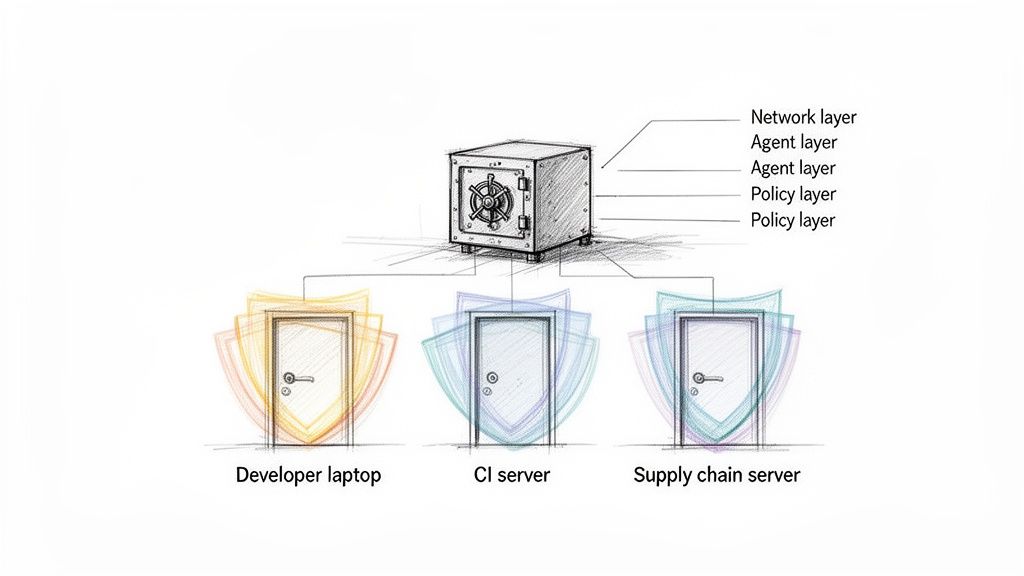
This platform goes far beyond traditional antivirus software, which mostly just scans for threats that are already known. Instead, Check Point provides a suite of proactive defences designed to stop attacks before they can even run. For example, if a developer receives a phishing email with a malicious Word document, traditional antivirus might miss it. Check Point’s Threat Emulation technology, however, opens the file in a secure virtual sandbox, observes its malicious behavior (like trying to encrypt files), and blocks it before it ever reaches the developer’s machine.
Why It’s More Than Just Antivirus
This modern approach is crucial for any organisation building and selling products with digital components, especially if you’re targeting the European market. Upcoming regulations like the EU’s Cyber Resilience Act (CRA) are mandating “security by design.” This isn’t just a buzzword; it means security can no longer be a last-minute addition. It has to be integrated from the very start of the product lifecycle.
Locking down the endpoints where your products are born is the most critical first step. Check Point’s solution, particularly its Harmony Endpoint product, helps you build that secure development environment. The goal is to prevent malware, exploits, and ransomware from ever compromising the tools your team relies on every single day.
Securing the development environment is foundational. It ensures that vulnerabilities are not inadvertently introduced into the software supply chain, protecting the integrity of the final product from its inception.
To really get a handle on modern endpoint protection, it’s helpful to understand the landscape, including concepts like XDR and MDR in cybersecurity. This context helps clarify how solutions like Check Point deliver much more advanced detection and response capabilities. By securing your development endpoints first, you establish a strong foundation for building resilient, compliant, and trustworthy connected devices that can meet the toughest regulatory standards.
Key Capabilities for Device and IoT Manufacturers
When you’re building products, security features only matter if they solve real-world problems. For device and IoT manufacturers, Check Point Endpoint Security isn’t just a collection of tools; it’s a robust defence system designed to protect the very environments where your products are designed, built, and tested.
Let’s break down what that means in practice.
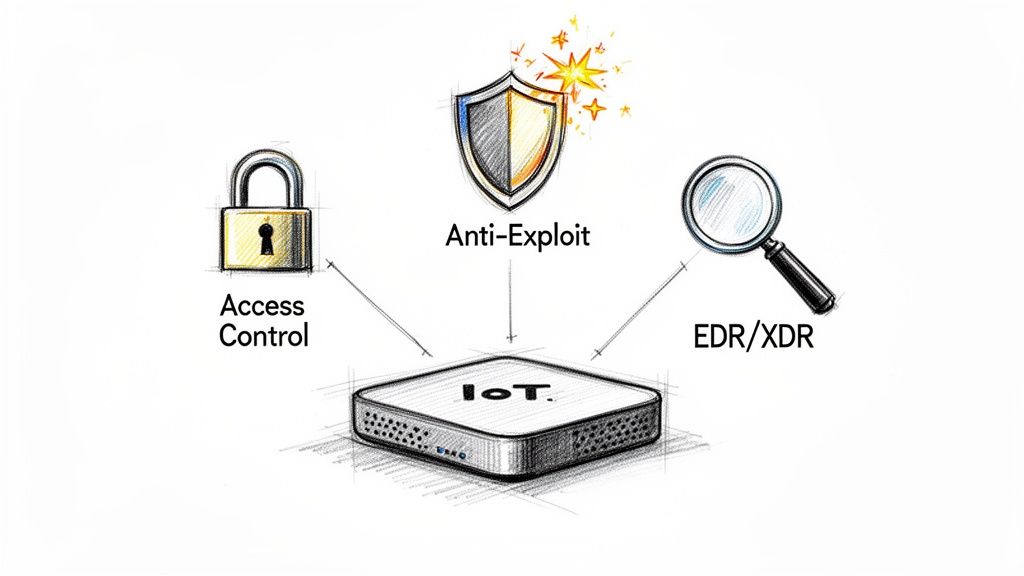
The protection is layered, with several core capabilities working in concert. These aren’t just abstract concepts—they are practical solutions for the security challenges you face every day in your development pipeline.
Proactive Threat Prevention
Check Point’s philosophy moves security from a reactive chore to a proactive strategy. A perfect example is its Anti-Exploit technology.
Imagine your team uses a common open-source library in your product’s firmware. Suddenly, a zero-day vulnerability is discovered in that library. Before you even have a patch, attackers could try to weaponise it against your developers’ machines. Anti-Exploit steps in here, blocking the malicious behaviour itself—like a buffer overflow or remote code execution attempt—and stopping a potential supply chain attack before it gains a foothold.
This is a critical distinction. It neutralises threats based on how they act, not just what they look like (their signature). This approach effectively shields your entire development lifecycle from unexpected attacks that might be lurking in third-party code.
Granular Access Control and Data Protection
Controlling who touches your sensitive product data is non-negotiable. Check Point gives you the power to enforce strict access policies on every endpoint, ensuring only authorised personnel can interact with source code, intellectual property, and firmware build systems.
For instance, you can create a policy that blocks a developer from copying the source code for a proprietary algorithm to a USB drive. If they try, the action is blocked, logged, and an alert is sent to the security team. This is backed by features like full-disk encryption and port control, creating a formidable defence against both accidental data leaks and intentional theft.
This level of control is not just a best practice; it’s a critical component for safeguarding intellectual property and ensuring the integrity of your product before it ever reaches the market.
This need for tight endpoint security isn’t unique to manufacturing. The Banking, Financial Services, and Insurance (BFSI) sector, for instance, held a 25.9% share of the Europe endpoint security market, driven partly by a 40% increase in bank-targeted cyberattacks in 2022. The high stakes in finance mirror the need for robust security in firmware development, especially as new EU regulations raise the bar for everyone. You can see how market trends reflect these regulatory pressures over at Market Data Forecast.
To help connect the dots, this table maps Check Point’s features to the specific security challenges manufacturers face.
Mapping Check Point Features to Manufacturer Security Needs
| Check Point Feature | Relevance for Device Manufacturers | Practical Example |
|---|---|---|
| Anti-Exploit & Threat Emulation | Protects the development environment from zero-day attacks hidden in third-party code, preventing supply chain compromises. | A developer unknowingly downloads a compromised open-source library. Anti-Exploit blocks the malicious code execution, preventing malware from embedding itself in the product firmware. |
| Full-Disk Encryption & Port Control | Safeguards intellectual property (source code, schematics) from physical theft or unauthorised data transfer via removable media. | An engineer's laptop containing sensitive product designs is lost or stolen. Full-disk encryption ensures the data remains inaccessible to unauthorised parties. |
| Endpoint Detection and Response (EDR) | Provides deep visibility and forensic data for incident analysis, which is critical for post-market surveillance and regulatory reporting. | A connected device in the field shows anomalous behaviour. EDR data from the build server helps trace the issue back to a specific code commit, speeding up root cause analysis. |
| Access Control Policies | Enforces least-privilege principles, ensuring that developers and engineers can only access the data and systems required for their roles. | A policy prevents junior developers from accessing the final production signing keys, reducing the risk of accidental or malicious misuse. |
This mapping shows how a comprehensive endpoint security solution moves beyond simple antivirus to become an integral part of a secure product lifecycle.
Advanced Detection and Response
Once your product is on the market, visibility becomes key to surveillance and compliance. Check Point’s Endpoint Detection and Response (EDR) and Extended Detection and Response (XDR) technologies deliver the deep insight you need to monitor for threats across your entire infrastructure.
Here’s how it helps your team:
- Deep Forensics: EDR automatically records and analyses endpoint activity. If a threat pops up, it generates a detailed incident report. For instance, if an attacker uses PowerShell to move laterally, the EDR report will show the exact commands executed, the user account involved, and every file that was touched.
- Rapid Response: If a developer’s machine is compromised, EDR can automatically isolate it from the network. This contains the threat immediately, stopping it from spreading to other systems like the central code repository.
- CRA Alignment: This kind of forensic data is exactly what you need for the documentation and reporting obligations under the Cyber Resilience Act. Understanding those duties is a big part of compliance; for more on this, check out our detailed guide on CRA vulnerability handling.
How to Evaluate Check Point for Your Security Programme
Moving past a simple feature list is essential. A proper evaluation framework is what tells you if a security solution truly fits your organisation’s real-world needs. When you’re looking at Check Point Endpoint Security, the goal is to map its capabilities directly onto your product security goals and, crucially, your compliance obligations—especially with new rules like the EU’s Cyber Resilience Act (CRA) coming into force.
This means asking practical, targeted questions that connect a technical feature to a business outcome. A good assessment gives you a clear “yes” or “no” on whether the platform is a strategic fit, not just another tool in the box.
A Regulation-Aware Evaluation Checklist
To conduct a meaningful review, you need to see how the solution tackles your specific regulatory and operational headaches. A compliance-first approach ensures that your investment directly supports market access in places like the EU.
Start with these critical evaluation points:
Vulnerability Handling Support: How does the platform’s EDR and forensics data help your team hit the CRA’s tight vulnerability reporting deadlines? For instance, if EDR detects a malicious process on a build server, can you generate a report that shows the process’s full lineage, from initial execution to every file it accessed? This data is crucial for proving to regulators that you have visibility and control.
Software Update Security: Does the solution help you lock down the CI/CD pipeline and the developer workstations where your software updates are actually built and signed? A compromised build environment is a direct route to malicious updates—a massive compliance failure under the CRA. Can you, for example, set a policy that blocks any unsigned code from running on a build server, preventing an attacker from injecting their own malicious binary into the update package?
Threat Intelligence Integration: How does the threat intelligence feed protect your development environment from emerging threats that specifically target manufacturers? For instance, if a new ransomware strain is known to exploit a specific remote desktop protocol, does the platform automatically update its rules to block that activity on your engineers’ laptops, providing proactive defence?
A successful evaluation boils down to one thing: translating features into compliance evidence. If a tool’s capabilities can’t be clearly documented to satisfy a regulatory control, its value drops dramatically in a regulated market.
Mapping Features to Compliance Controls
Connecting features to specific security frameworks is a powerful way to justify your decision. Many of the CRA’s security requirements are nothing new; they align with established standards. If you need to brush up on these frameworks, you can learn more about how controls like those in NIST SP 800-53 relate to CRA compliance and build a stronger foundation for your evaluation.
Think about how Check Point’s features map directly to these kinds of controls:
- Access Control: You can use the platform to enforce least privilege. For example, you can create a policy group for interns that blocks access to the production code repository while allowing access to the sandboxed development environment, directly addressing the need for secure development controls.
- Incident Response: The EDR’s automated isolation and forensic reporting are perfect for demonstrating a structured, timely response. When a machine is isolated, you can show auditors the exact timestamp of the action and the complete forensic report generated by the system.
- System and Information Integrity: Threat emulation and anti-exploit features are your evidence that you’re proactively protecting development systems. You can point to a log showing that an attempted zero-day exploit against a developer’s browser was blocked, proving the integrity of the system was maintained.
By framing your evaluation around these pointed questions and compliance mappings, you can confidently decide if Check Point Endpoint Security is the right strategic investment to secure your products and keep you market-ready. This approach shifts the conversation from “what does it do?” to “how does it solve our specific compliance and security problems?”
Choosing Your Deployment Model: On-Premise vs Cloud
Deciding how to deploy your Check Point Endpoint Security solution is a critical fork in the road. This choice directly shapes your costs, the level of control you have, and how easily you can scale down the line. You have two main paths: the traditional on-premise setup, where you host and maintain everything yourself, or a cloud-based model managed through Check Point’s Harmony Endpoint. Each has its place, and the right one really depends on your organisation’s DNA.
An on-premise deployment gives you absolute, hands-on control over your security infrastructure and data. For organisations bound by strict data sovereignty rules or operating in highly regulated industries, this isn’t just an option—it’s often a requirement. A medical device manufacturer, for instance, might go this route to guarantee that sensitive patient data never leaves their physical premises, ticking a crucial regulatory box.
The On-Premises Approach: Control and Compliance
When you choose on-premise management, your team takes the wheel for everything. That means initial server setup, ongoing maintenance, updates, and backups are all on you. It’s a bigger upfront lift, both in hardware costs and IT overhead, but it grants you maximum authority over your security policies and where your data lives.
This model is the natural fit for:
- Organisations with ironclad, pre-existing data governance policies. For example, a defence contractor might be legally prohibited from having any security logs stored on third-party cloud infrastructure.
- Companies that must comply with specific data sovereignty laws.
- Environments where security data simply cannot travel over public networks.
But that control comes with a trade-off: flexibility. Scaling up means buying and configuring new hardware, and managing a global team of remote workers can get complicated fast.
This decision tree helps visualise the key questions you should be asking as you map out your security needs, from how you handle vulnerabilities to your update strategy.
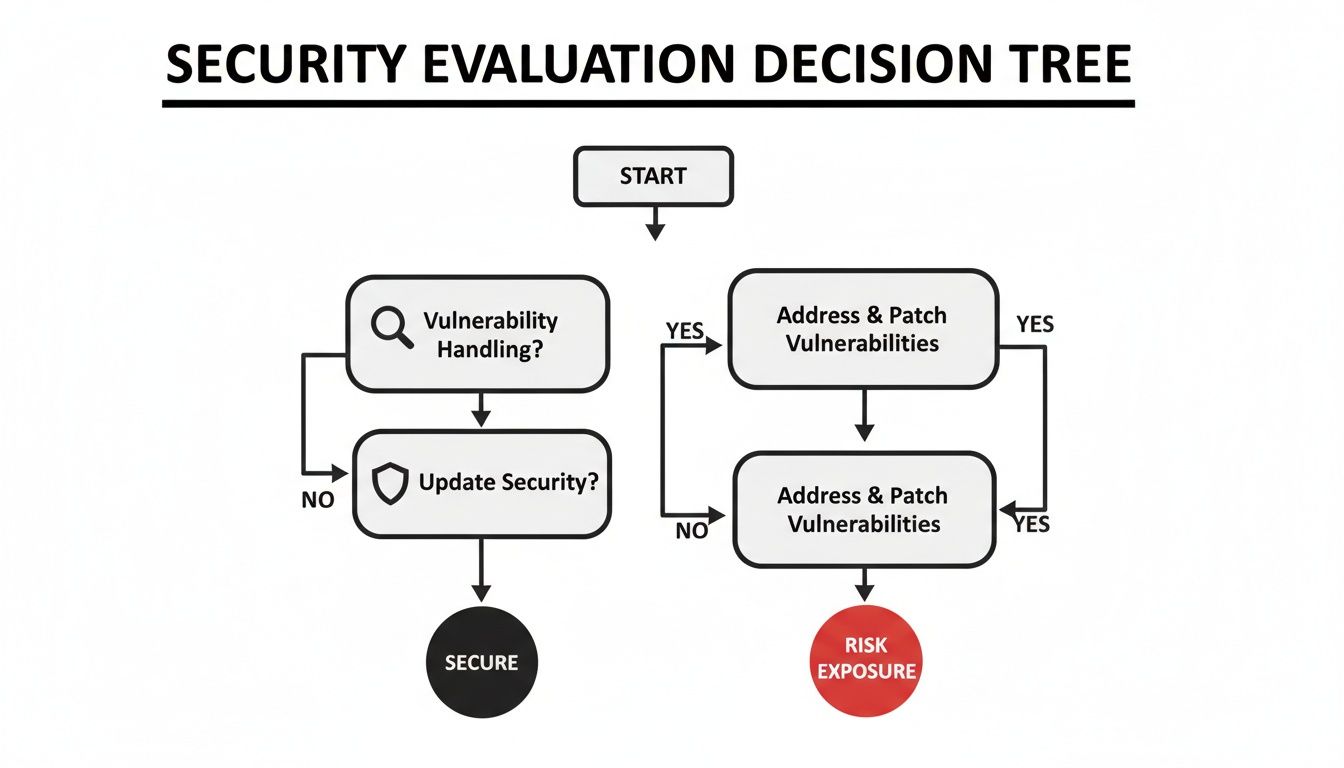
As the flowchart shows, different security priorities will lead you down different paths, ultimately shaping both your deployment choice and your day-to-day operations.
The Cloud Model: Agility and Scalability
On the other side of the coin, the cloud-based Harmony Endpoint offers a far more agile and scalable solution. Check Point handles the management infrastructure, liberating your team from the tedious work of server maintenance. It’s a perfect match for fast-growing IoT startups or companies with a distributed workforce. For example, a company with developers in Europe, Asia, and North America can manage security policies for all of them from a single web-based console without worrying about latency or server maintenance in each region. Getting a handle on the core differences between on-premises vs cloud computing is a great first step in making this choice.
Market data clearly shows the direction of travel. While the European endpoint security market was valued at USD 4,374.48 million, the cloud deployment segment is expanding at an explosive 22.1% CAGR. This growth is fuelled by the scalability and lower operational costs that are so critical for manufacturers grappling with new regulations like the Cyber Resilience Act.
For most modern device manufacturers, the cloud model strikes the right balance between robust security and operational efficiency. It lowers the total cost of ownership while ensuring your security posture can keep up with a global footprint.
Ultimately, picking the right model means balancing your need for control against your budget and operational agility. Just like understanding the fundamentals of open-source firewalls is key to network defence, knowing your deployment options is the first real step toward building a security posture that works for you.
Integrating Check Point Into Your Workflow
A powerful security tool is only as good as its integration into your team’s daily rhythm. Bringing Check Point Endpoint Security into the fold isn’t about adding another dashboard to stare at; it’s about weaving advanced protection directly into the fabric of your development and security operations. The real goal here is to make security a natural, automated part of how you build and ship products.
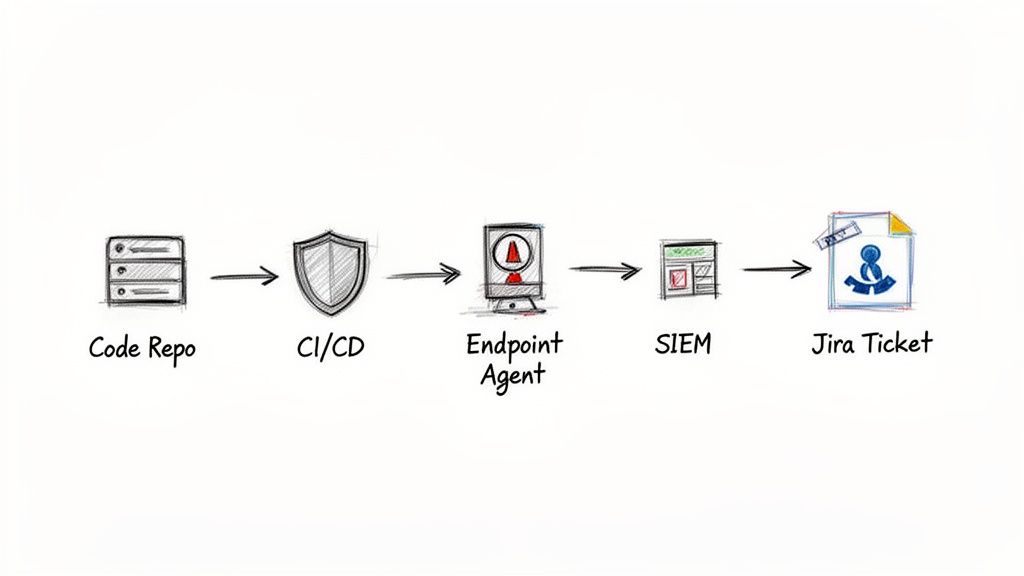
This all starts with plugging Check Point into your broader security ecosystem. Its ability to push logs and alerts to Security Information and Event Management (SIEM) platforms is non-negotiable. For instance, when Check Point logs a blocked connection attempt on a developer’s laptop, sending that log to your SIEM allows you to correlate it with firewall logs and see if the same malicious IP address is also trying to scan your network perimeter.
Connecting to Your Development Pipeline
For any device manufacturer, securing the software supply chain is everything. Check Point can be hooked into your Continuous Integration/Continuous Deployment (CI/CD) pipelines, acting as another layer of validation. By keeping an eye on the build servers and developer workstations that touch your code repositories, it helps you prove that malware isn’t being injected into your software before it ever gets out the door.
A really practical example of this is automating your incident response workflow.
Imagine Check Point’s EDR spots suspicious behaviour on a developer’s machine—maybe an unauthorised process trying to grab code signing keys. Instead of just firing off an email alert that could get buried, the system can be configured to automatically trigger an API call.
That call can instantly create a high-priority incident ticket in a system like Jira. The ticket comes pre-loaded with all the crucial forensic data from the EDR and is assigned directly to the incident response team. This simple automation collapses response time from hours to mere minutes, letting you contain threats before they have a chance to escalate. For teams wanting to build similar workflows, understanding the mechanics of a GitLab to Jira integration provides a valuable blueprint for connecting your dev and security toolchains.
Managing Operational Realities
Beyond the technical connections, a successful integration has to tackle the human side of things. A common worry is the performance hit a security agent might have on developer machines. While Check Point’s agent is designed to be lightweight, it’s absolutely crucial to test it on your standard developer builds. This lets you fine-tune policies and create exclusions for legitimate development tools—like a code compiler or virtual machine—so they don’t get bogged down by unnecessary scanning.
Policy management is another key piece of the operational puzzle. Your organisation isn’t a monolith; you have different teams—from firmware engineers to web app developers—each with unique workflows and toolsets.
Check Point allows you to create granular policies for different user groups, ensuring security controls don’t grind productivity to a halt. For example, your firmware team’s policy might block all USB devices to prevent firmware leaks, while the marketing team’s policy allows approved, encrypted USB drives for transferring presentation files. This tailored approach makes security feel less like a roadblock and more like a helpful guardrail.
Finally, training is non-negotiable. Your team needs to know how to interpret alerts, manage policies, and use the forensic tools properly. This ensures you’re getting the most out of the platform, turning it from just another tool into an efficient and effective part of your daily security posture.
A Balanced Look at Strengths and Limitations
No single security tool is a magic bullet, and a real-world evaluation means being honest about where a platform shines and where its boundaries are. For any manufacturer assessing Check Point Endpoint Security, it’s crucial to understand this balance to see how it fits with your specific operational realities.
The platform’s biggest advantage is its prevention-first philosophy, all managed through a unified security architecture. This is a massive plus for complex development environments. For example, a security admin can create one policy that blocks malicious websites, prevents data transfer to USB drives, and enables ransomware protection, and then apply it to the entire developer group with a single click.
Key Strengths for Manufacturers
For product security teams, the benefits are clear and direct.
- Unified Management: A single console for creating policies and monitoring threats across all IT endpoints cuts down on admin overhead. More importantly, it dramatically lowers the risk of misconfigurations that leave gaps for attackers.
- Advanced Threat Prevention: Technologies like Anti-Exploit and Threat Emulation are exceptionally good at shutting down zero-day attacks. A practical example is stopping an attacker who tries to exploit a browser vulnerability to gain control of a developer’s machine and access the source code.
- Strong Forensics: The detailed reporting from its EDR capabilities gives you the concrete evidence needed for regulatory audits. When an incident occurs, you can export a report showing the entire attack chain, which is exactly the kind of data that helps meet strict CRA reporting requirements.
Potential Limitations to Consider
Of course, there are areas where you’ll likely need to supplement your strategy. The agent, while efficient, still has a resource footprint that might be noticeable on the older or lower-powered test devices common in hardware labs. You can definitely tune policies to minimise this—for example, by scheduling full scans to run only during off-hours—but it’s something to watch closely during a proof-of-concept.
The most important distinction for IoT vendors is that Check Point secures the IT endpoints used to build your products, not the resource-constrained embedded devices themselves. An endpoint agent designed for a Windows server simply isn’t built for a low-power microcontroller.
On top of that, highly specialised Operational Technology (OT) or industrial control system (ICS) environments might require bespoke security rules that go beyond standard IT endpoint configurations. While Check Point is great for securing the engineering workstations in these places, protecting a programmable logic controller (PLC) on a factory floor often demands specialised tools designed for OT protocols.
Recognising these limitations isn’t a weakness; it allows you to build a more resilient, layered security strategy where Check Point serves as the core defence for your development lifecycle.
Common Questions Answered
When product security teams and manufacturers look into Check Point, a few questions always come up. Here are some quick, practical answers to help you weigh the solution.
How Does Check Point Help With CRA Vulnerability Handling?
Check Point’s Endpoint Detection and Response (EDR) gives you a powerful lens into your development environments, letting you spot and pick apart threats before they cause damage. This is a huge help for meeting the Cyber Resilience Act’s demands for monitoring and incident reporting.
Think of it this way: if a strange process kicks off on a build server, Check Point’s forensic tools let your team trace it back to its source. That root-cause analysis is exactly what you need for the detailed reporting the CRA mandates. For example, you can show regulators a report detailing that “Process A spawned Process B, which attempted to access signing keys at 10:15 AM and was automatically terminated,” providing clear evidence of your response.
Can Check Point Secure Both IT Endpoints and Our Connected Products?
Check Point is laser-focused on securing traditional IT endpoints—the laptops, servers, and workstations that make up your product development pipeline. This is non-negotiable for blocking supply chain attacks. For example, it can prevent a compromised developer laptop from injecting malware into the firmware image stored on a build server.
It’s important to be clear, though: it is not built to run on resource-constrained IoT devices out in the field. For that job, you’d need a specialised, embedded security agent. The way to think about it is that locking down your development environment with Check Point Endpoint Security is the first, essential step to ensuring the products you ship are clean.
Is the Cloud-Managed Harmony Endpoint Suitable for Strict Data Residency Rules?
Yes, absolutely. Check Point built its cloud services with global compliance in mind. They run data centres across different regions, including within the EU, so you can choose exactly where your security data is stored and handled.
This setup lets you get all the benefits of cloud management—like scalability and ease of use—while still ticking the boxes for data residency laws like GDPR or your own internal governance rules.
So, a German company can use Harmony Endpoint’s cloud platform while configuring it to ensure all its security logs and forensic data are stored exclusively in the Frankfurt data centre, satisfying local data sovereignty requirements. As always, it’s smart to confirm the exact data centre locations with Check Point when you’re evaluating the solution.
Navigating the Cyber Resilience Act requires a clear, structured approach. Regulus provides a comprehensive platform to assess CRA applicability, generate a tailored requirements matrix, and build an actionable compliance roadmap. Gain clarity and confidently place compliant products on the European market with Regulus.


