

An ISO 27001 ISMS certification is the official seal of approval showing that your company’s Information Security Management System (ISMS) meets a tough international standard. It’s more than just a certificate; it’s a clear, strategic signal to customers and partners that you take information security seriously and manage risks in a systematic way.
Why ISO 27001 ISMS Certification Is a Strategic Advantage
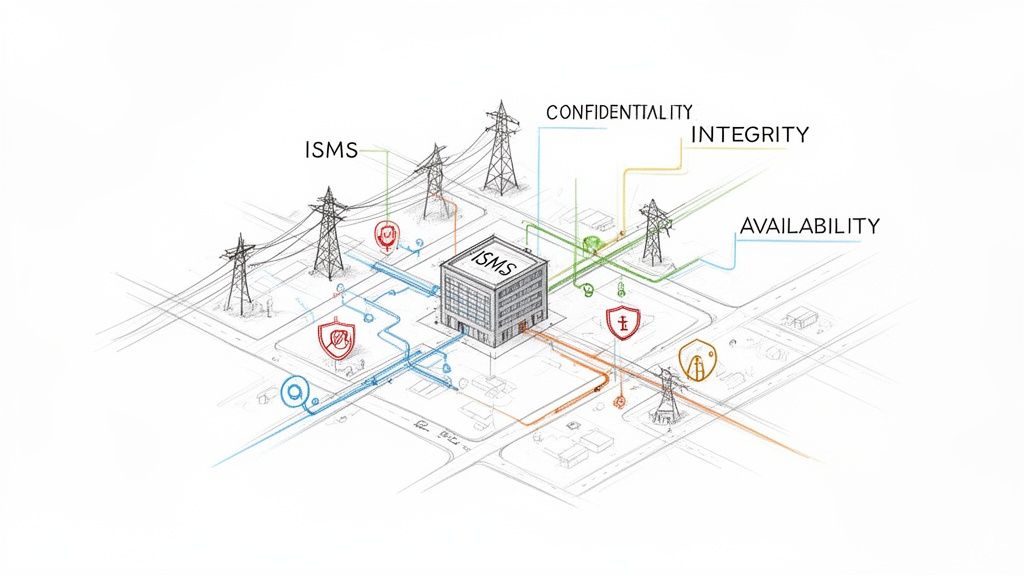
It’s easy to fall into the trap of seeing ISO 27001 as just another technical task to tick off a list. That’s a mistake. A better way to think about your ISMS is like the essential infrastructure of a modern city.
A city isn’t secure because it has one big wall or a handful of guards. Its real strength comes from a network of systems all working in concert—roads for emergency access, a stable power grid, and coordinated response services. Each piece plays its part. An ISMS works the same way, creating a holistic framework to manage security risks across the entire organisation, not just in isolated pockets.
The Core Principles in Action
At the very heart of any good ISMS are three principles, often called the CIA triad. These are the pillars that make sure your data is protected in a structured, consistent, and verifiable manner.
- Confidentiality: This is about making sure information isn’t shared with unauthorised people, systems, or processes. A practical example is using role-based access control (RBAC) to ensure that only HR managers can view employee salary information.
- Integrity: This means keeping your information accurate, consistent, and trustworthy throughout its entire existence. For instance, using digital signatures on a contract ensures that the document hasn’t been altered after being signed.
- Availability: This ensures that authorised people can access and use the information whenever they need to. A practical example is having redundant servers for a critical e-commerce website to ensure it stays online even if one server fails.
Think about a manufacturer of smart home IoT devices. They must ensure video feeds are encrypted and viewable only by the authorised user (Confidentiality). They also need to stop anyone from tampering with the device’s firmware (Integrity). And finally, their cloud platform has to stay up and running so customers can actually access their data when they want to (Availability).
Unlocking Market Access and Building Trust
Earning an ISO 27001 certification gives your organisation a major leg up in the broader compliance landscape. It’s a powerful statement of commitment, particularly for manufacturers and vendors getting ready for new EU regulations.
Upcoming rules like the Cyber Resilience Act (CRA) demand a structured approach to security from the get-go. Having an ISMS already in place provides a rock-solid foundation for meeting these new demands. It serves as tangible proof of due diligence, making regulatory conversations smoother, speeding up partner onboarding, and ultimately opening doors to new markets by proving you’re a reliable guardian of sensitive information.
Understanding the Core Requirements for Certification
Getting started with ISO 27001 ISMS certification can feel a bit like planning a major construction project. Before you even think about laying a foundation, you need a solid blueprint. This section is that blueprint, breaking down the essential deliverables you’ll need to build a certifiable Information Security Management System (ISMS).
These aren’t just bureaucratic papers to be filed away; they are the living documents that define, protect, and prove your security posture. Think of them as the architectural plans, material specs, and structural tests for your security framework.
Defining Your ISMS Scope
The very first job is to draw the boundaries of your ISMS, a process known as scoping. You can’t protect everything all at once, and honestly, you shouldn’t even try. Scoping is a strategic decision about which parts of your organisation the certification will actually cover.
Imagine an IoT camera manufacturer getting ready for its audit. Their biggest worries are the security of the product itself and the customer data it collects and stores.
- A Practical Take on Scoping: The company decides its ISMS scope will cover the entire lifecycle of its flagship smart camera. This includes the firmware development team, the cloud platform where user footage is stored, and the mobile app people use to view their camera feed. They consciously decide to leave their internal HR and finance systems out for now, as they are separate and pose a lower risk. This tight focus makes the certification journey manageable and directly relevant to the product’s security.
By clearly defining what’s “in” and what’s “out,” you create a realistic and defensible boundary for your auditor. It’s the best way to avoid scope creep, a common pitfall that makes projects spiral into something too big and complex to ever finish.
Conducting a Thorough Risk Assessment
With your scope locked in, the next crucial step is the risk assessment. This is where you methodically identify, analyse, and evaluate potential threats to the information inside your defined scope. It’s far less about guessing and much more about structured, repeatable analysis.
The process boils down to answering three fundamental questions:
- What could possibly go wrong? (Identify Threats and Vulnerabilities)
- If it did, how bad would it be? (Assess Impact)
- What are the chances of it happening? (Assess Likelihood)
Back to our IoT camera company. Their risk assessment might uncover a very specific threat: a hacker trying to get unauthorised remote access to a user’s live camera feed. They would evaluate the severe impact of this breach (a massive privacy violation and reputational disaster) and its likelihood.
From there, they’d identify a clear control to put in place, such as mandatory end-to-end encryption for all video streams. This control directly neutralises the risk they identified, forming the core of their risk treatment plan. Properly managing risks like this is also a central theme in new regulations; you can explore how this connects to product compliance by reviewing guidance on CRA logging and monitoring requirements.
Creating the Statement of Applicability
The Statement of Applicability (SoA) is arguably the single most important document you will produce on your ISO 27001 journey. It’s the central blueprint that connects your risk assessment directly to the security controls you choose to implement. It lists all 93 controls from ISO 27001’s Annex A and forces you to document three key things for each one:
- Is this control relevant to my ISMS?
- Have I implemented it?
- Why did I make that decision?
The SoA is your organisation’s definitive declaration of its security posture. For an auditor, it provides a transparent and efficient roadmap, showing exactly what you are doing to manage risks and why. It removes ambiguity and demonstrates methodical decision-making.
For example, our camera manufacturer would mark the cryptography control (A.8.24) as “Implemented” and justify it by stating, “End-to-end encryption is applied to all user video data in transit and at rest to protect confidentiality.” On the flip side, they might mark a control for physical security in public areas (A.7.3) as “Not Applicable,” justifying it with, “Our data centres are not accessible to the public, so this control does not apply.”
This document becomes the primary reference point during an audit, making your ISMS transparent and much easier to defend.
To pull it all together, here’s a quick summary of the key deliverables you’ll be creating. Think of it as a checklist for your team to ensure nothing gets missed before the auditors arrive.
Key ISMS Deliverables for ISO 27001 Certification
| Deliverable | Purpose | Practical Example |
|---|---|---|
| ISMS Scope Document | To clearly define the organisational, physical, and technical boundaries of your ISMS. | An IoT company defines its scope to include product development and cloud services but excludes internal corporate IT. |
| Risk Assessment Report | To identify, analyse, and evaluate information security risks within the defined scope. | Identifying "unauthorised access to camera feeds" as a high risk and documenting its potential impact. |
| Risk Treatment Plan | To outline the actions and controls selected to mitigate the identified risks. | A plan detailing the implementation of end-to-end encryption to address the risk of unauthorised access. |
| Statement of Applicability | To document which Annex A controls are implemented and justify the inclusion or exclusion of each. | Listing control A.8.24 (Cryptography) as implemented to protect customer data, with a clear justification. |
With these core documents in place, you’ve built the foundation of a robust and certifiable ISMS. They demonstrate that your security programme is not just a collection of random tools but a thought-out, risk-driven system.
The Path to Your ISO 27001 Certification
Getting your ISO 27001 ISMS certification isn't a single event; it's a structured journey with clear, sequential stages. Think of it less like a sprint and more like a well-planned expedition, moving your organisation from its current security state to one that is internationally recognised and verified. This path ensures your Information Security Management System (ISMS) is not just designed correctly but actually works in practice.
As you move through these stages, a solid framework is essential. Understanding the principles of Security Program Management (SPM) can provide a structured approach, especially for smaller businesses trying to implement and maintain an ISMS.
The process boils down to a few foundational steps: scoping, assessing, and documenting. These underpin the entire certification process.
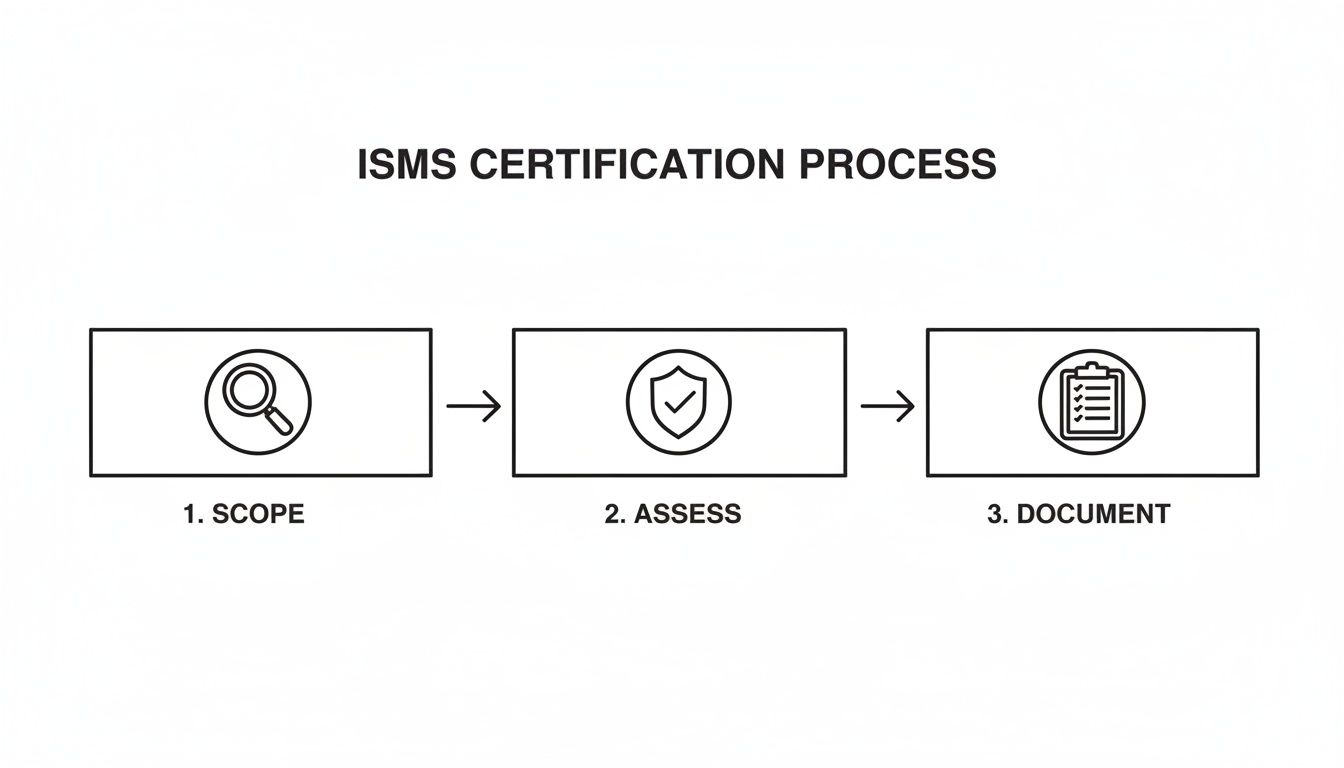
This visual shows how each phase builds on the last, creating a logical flow from initial discovery to formal, audit-ready documentation.
The Gap Analysis: Your Diagnostic Check-Up
Every journey starts with knowing your location. The Gap Analysis is exactly that—a thorough diagnostic check-up for your information security. The goal is to compare what you're already doing—your existing security practices, policies, and controls—against the specific requirements of the ISO 27001 standard.
This process shines a light on where you already meet the standard and, more importantly, where you fall short. It’s an absolutely essential first step that prevents wasted effort and gives you a clear, actionable roadmap for the work ahead.
Here’s a practical example: A mid-sized fintech company runs a gap analysis and discovers their access controls for production servers are strong. However, their process for employee onboarding and offboarding is informal and isn't consistently documented. This gap immediately becomes a top priority to fix during implementation.
Implementation: Building Out Your ISMS
Once you have the findings from your gap analysis, you move into the Implementation phase. This is the hands-on part. You'll be actively building your ISMS by creating the necessary policies, procedures, and technical controls to close the gaps you identified.
This involves writing documentation, training your team, and often deploying new security tools or processes. It’s where you turn the theoretical requirements of the standard into the practical, day-to-day operations of your organisation. To keep things on track, it's smart to see how a thorough CRA risk assessment can inform and strengthen your implementation efforts.
The Internal Audit: A Full Dress Rehearsal
Before you bring in the external auditors, you must conduct an Internal Audit. This is your dress rehearsal. The audit is performed by an impartial team within your organisation (or a third-party consultant acting on your behalf) to test the effectiveness of your brand-new ISMS.
This stage is invaluable. It gives you a safe environment to find and fix any remaining issues before the official audit, which massively increases your chances of passing the first time around. It simulates the real thing and prepares your team for the questions and evidence they’ll need to provide.
The Two-Stage External Audit
When you're confident in your ISMS, it’s time for the official External Audit. This happens in two distinct stages.
- Stage 1 Audit (Documentation Review): The external auditor comes in to review all your ISMS documentation. They are checking to see if your system is designed correctly on paper and meets all the standard’s requirements. They’ll look at your scope, policies, Risk Assessment Report, and Statement of Applicability. It’s basically a check to make sure you've built a solid foundation.
- Stage 2 Audit (Implementation Audit): This is the "live" audit. The auditor returns, usually a few weeks or months later, to verify that your ISMS isn’t just well-documented but is actually working effectively in the real world. They will interview staff, observe processes, and review records to see your controls in action. A practical example here is the auditor asking a new employee to describe the security training they received during onboarding, then checking HR records to verify it happened.
Surveillance and Continual Improvement
Achieving your ISO 27001 certification isn't the finish line. Your certificate is valid for three years, but to keep it, you have to undergo annual Surveillance Audits.
These are smaller, periodic check-ins to ensure your ISMS is being maintained and, just as importantly, continually improved. This ongoing commitment demonstrates that security is an integral part of your company culture, not just a one-off project.
Gaining an Edge in the EU Market with CRA Compliance
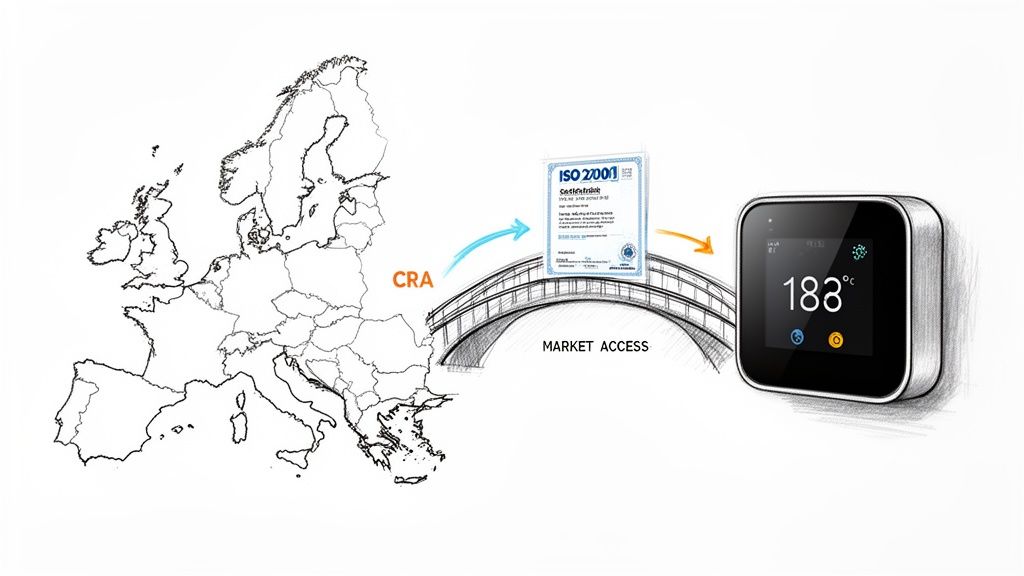
For companies making products with any digital component, an ISO 27001 ISMS certification is far more than a security badge. It's a fast-track pass for accessing the European Union market.
With new regulations like the EU's Cyber Resilience Act (CRA) coming into force, proving your security posture isn't just a good idea—it’s a non-negotiable requirement for market entry.
The good news? ISO 27001 doesn't just "align" with the CRA; it gives you a running start. The standard's structured approach to risk and security controls provides tangible, verifiable proof that your organisation builds security in from the ground up.
Building a Foundation for Secure-by-Design
The entire CRA philosophy is built on the idea of secure-by-design. In simple terms, this means manufacturers must weave security into every single phase of a product's life, from the first sketch to post-market support. An ISMS certified to ISO 27001 is a perfect fit for this mandate.
The risk management framework you build for your certification is exactly the kind of framework the CRA demands for product security. It establishes a repeatable, evidence-backed process for spotting threats and implementing controls—precisely what EU regulators are looking for.
For example, the CRA requires manufacturers to identify and document all cybersecurity risks tied to their products. If you're ISO 27001 certified, you've already done this through your mandatory risk assessment process. You simply adapt that existing work to focus specifically on product-level vulnerabilities.
This overlap means CRA compliance isn't some brand-new, overwhelming task. It becomes a natural extension of the security programme you already have.
Mapping ISO 27001 Controls to CRA Requirements
The real power of your ISMS is how cleanly its controls map to CRA obligations. Many of the security measures detailed in Annex A of ISO 27001 provide the exact evidence you need to prove compliance.
- Secure Development (A.8.28 in 2022 version): This control demands you establish and apply secure coding rules. For a practical example, a team might use static analysis security testing (SAST) tools in their CI/CD pipeline to automatically scan code for common vulnerabilities like SQL injection before it can be deployed. This lines up perfectly with the CRA’s requirement that products be designed and developed to prevent security holes.
- Vulnerability Management (A.8.8 in 2022 version): ISO 27001 requires a formal process for finding and fixing technical vulnerabilities fast. This is a core pillar of the CRA, which mandates structured processes for handling security flaws after a product launch.
- Incident Management (A.5.26 in 2022 version): A documented incident response plan is essential for ISO 27001. That very same plan can be used to meet the CRA’s strict reporting deadlines for discovered vulnerabilities.
This direct mapping means your certification efforts are doing double duty. To see how these pieces fit into a broader strategy, check out our in-depth guide on building a Cyber Resilience Act compliance roadmap.
A Practical Example of CRA and ISO 27001 Synergy
Let's imagine a company that makes smart thermostats and holds an ISO 27001 ISMS certification. Their ISMS includes a solid incident response plan that's been tested and audited.
One day, a security researcher finds a flaw in the thermostat's firmware and reports it. Because the company is ISO 27001 certified, they already have a process ready to go. The security team triggers their incident response plan, confirms the vulnerability, and starts developing a patch.
Under the CRA, they have to report this actively exploited vulnerability to ENISA within 24 hours. Thanks to their ISO 27001 framework, they hit this tight deadline without breaking a sweat, providing clear proof of their diligence and organised response.
This is how certification turns tough regulatory conversations into straightforward demonstrations of trust. Across Europe, the certification landscape is evolving as firms race to adopt the ISO 27001:2022 standard before the 31 October 2025 deadline.
For IoT vendors and embedded device makers, this investment can slash vendor audit friction by 60-80% and speed up onboarding with EU partners—a critical advantage for supply chain roles under the CRA.
Ultimately, holding an ISO 27001 certificate is compelling evidence that you have a working, effective security management system. In the EU market, that gives you a clear and sustainable competitive edge.
Avoiding Common Pitfalls on Your Certification Journey
Getting your ISO 27001 ISMS certification is a huge win, but the road to get there is often paved with the same predictable challenges that can bog you down and drive up costs. If you know what these common missteps are ahead of time, you can navigate the whole process a lot more smoothly.
By anticipating these issues, you can turn potential roadblocks into opportunities to build an Information Security Management System (ISMS) that's genuinely stronger and more resilient. Let's break down the most frequent pitfalls and talk about practical, real-world solutions to keep your certification project on track.
Pitfall 1: An Ambiguous or Overly Ambitious Scope
One of the fastest ways to derail an ISO 27001 project is getting the scope wrong from day one. A lot of organisations make the classic mistake of trying to certify the entire company all at once. This "boil the ocean" approach almost always leads to overwhelming complexity, burnt-out teams, and a project that never quite makes it over the finish line.
Practical Example: A fast-growing SaaS company decides to go for ISO 27001. Eager to impress stakeholders, they declare the entire organisation—HR, finance, marketing, and every single product line—as in-scope. Before they know it, they're drowning in irrelevant risk assessments for departments with low security impact, and the whole project grinds to a halt under its own weight.
Solution: Start Small and Focused
The most effective strategy is to start with a single, high-value part of the business. Pick a core product, a specific cloud service, or the business unit that handles your most sensitive data. This focused approach keeps the process manageable and lets you score a quick win.
Once you’ve successfully certified that initial scope, you can methodically expand it in the following years. This iterative approach not only shows progress but also builds internal expertise, making the long-term goal of broader certification feel much more achievable.
Pitfall 2: Treating Certification as an IT-Only Project
Another classic mistake is seeing ISO 27001 as purely a technical problem to be dumped on the IT department's to-do list. When that happens, senior management tends to view the project as just another cost centre, not a strategic investment. This mindset inevitably leads to a lack of resources, a shoestring budget, and zero buy-in from other parts of the business.
Solution: Frame It as a Business Enabler
To get the support you need, you have to build a solid business case for certification. Shift the conversation away from technical controls and focus on the tangible benefits that actually matter to leadership.
- Accelerated Sales Cycles: Explain how certification dismantles security objections in enterprise deals, shortening the time it takes to close them. For example, show how having the certificate pre-answers 50% of a typical enterprise security questionnaire.
- Reduced Business Risk: Put a number on it. Show how a formal ISMS lowers the potential financial fallout of a data breach.
- Competitive Advantage: Demonstrate how certification sets you apart from the competition and opens up new markets with tough security requirements.
By framing ISO 27001 ISMS certification as a driver of growth and resilience, you elevate it from an "IT cost" into a strategic priority for the whole organisation.
Pitfall 3: The 'Set and Forget' Mentality
This is probably the most dangerous pitfall of all: treating certification as a one-time event. Some organisations work like crazy to create policies and procedures just to pass the audit, then let them gather digital dust on a server. This "set and forget" approach completely misses the point of ISO 27001, which is all about continual improvement.
Practical Example: A manufacturing firm passes its Stage 2 audit with flying colours. The team celebrates, and the comprehensive policies they developed are filed away. A year later, during the first surveillance audit, the auditor discovers that no management reviews have happened, risk assessments are outdated, and employees have forgotten their security duties. The company is now facing a major non-conformance and risks losing its certificate.
Solution: Embed Security into Your Culture
To avoid this fate, you have to weave ISMS activities into the normal rhythm of your business. Real security is an ongoing process, not a project with an end date. You can see how this philosophy connects to new regulations by reviewing our guide on CRA vulnerability handling.
- Schedule Quarterly Reviews: Block out time for regular ISMS management reviews to discuss performance, risks, and incidents.
- Integrate Security Tasks: Weave security responsibilities directly into existing job descriptions and team workflows.
- Automate Where Possible: Use tools to monitor controls and automate evidence collection, cutting down on the manual grind.
Adoption of ISO 27001 is surging across Europe as companies get ready for regulations like NIS2 and the CRA, with some platforms even enabling certification in as little as 2.5 months. This rapid timeline is critical for software manufacturers and product teams who need to meet CRA obligations for vulnerability disclosure and post-market surveillance. Data shows that in 2025, 81% of companies worldwide plan to hold or pursue certification, as ISO 27001's controls are proven to cut Annual Loss Expectancy by at least 20%. You can find out more by exploring these insights about top EU compliance platforms.
ISO 27001 is a Foundation for Future Resilience
Pursuing ISO 27001 ISMS certification is far more than a box-ticking exercise. Think of it as a strategic investment in your company’s resilience—it's not a finish line to be crossed, but the foundation you build a durable security posture on.
The process forces you to establish a framework for continuous improvement. Security stops being a reactive, fire-fighting task and becomes a core, proactive business function. The benefits are clear: a stronger, more defensible security posture, much deeper trust with partners and customers, and a massive head start in meeting tough regulations like the EU Cyber Resilience Act.
We're seeing this play out across Europe. The French group EPSA, for instance, recently locked in its ISO/IEC 27001 certification for 2025–2028, covering its cloud services and cybersecurity operations. As their press release makes clear, this isn't just about today; it's a strategic move to prepare for future regulations like NIS2 and the CRA. You can read more about EPSA’s ISO 27001 achievement on their website.
At its core, certification is about turning complex security and regulatory obligations from a burden into a competitive advantage. It’s a public statement that you are serious about protecting information, building a level of trust that opens doors in new markets and strengthens supply chains.
With a clear roadmap and the right tools, your organisation can navigate this process effectively. The end goal is to ensure your products are secure, compliant, and ready for whatever comes next.
ISO 27001 FAQs: Your Questions Answered
When you're diving into ISO 27001 ISMS certification, a lot of practical questions come up. This section gives you straight answers to the most common ones we hear, covering everything from timelines and costs to the latest updates in the standard.
How Long Does Certification Typically Take?
For most small to medium-sized businesses (SMEs), getting ISO 27001 certified is a 6 to 12-month journey. Of course, this isn't set in stone.
Your timeline really depends on a few key things: the complexity of your scope, how mature your security practices already are, and the resources you can throw at the project. An organisation starting from a blank slate will naturally take longer than one that’s already nailed many of the security fundamentals. A practical example: a 50-person tech startup with a well-defined product and cloud-native infrastructure might achieve certification in 6 months, whereas a 200-person manufacturing company with legacy systems might take over a year.
What Are the Estimated Costs for an SME?
For a small or medium-sized business, you should budget somewhere in the range of €10,000 to €50,000 for your first ISO 27001 certification. This is a broad estimate, but it breaks down into a few key areas:
- Consulting Fees: If you bring in an expert to guide you, this will likely be a significant part of your budget.
- Certification Body Fees: These are the direct costs for your Stage 1 and Stage 2 audits, plus the annual surveillance audits that follow.
- Internal Resources: Don't forget the cost of your own team's time spent on implementation, running internal audits, and management reviews.
- Technology and Tools: You might need to invest in new security software or tools to close gaps and meet specific control requirements. For example, you might need to purchase a new vulnerability scanning tool or a password manager for the entire company.
Is Hiring a Consultant Necessary?
It’s not mandatory, but hiring an experienced ISO 27001 consultant is a really good idea, especially for your first time. A good consultant helps you sidestep common mistakes, interpret the standard correctly, and generally speeds up the whole process.
Here’s a practical example: A seasoned consultant can help you define a scope that’s realistic and easy to defend. One of the biggest rookie errors is making the scope too broad, which creates a huge amount of unnecessary work. Their expertise often ends up saving you more time and money than it costs.
What Is the Difference Between ISO 27001:2013 and 2022?
The 2022 update brought some important changes to modernise the standard. The biggest shift happened in Annex A, which is the catalogue of security controls.
The control set was reorganised from 14 domains and 114 controls in the 2013 version to just 4 themes and 93 controls in the 2022 version. While many controls were simply merged or reworded, 11 new controls were added to tackle modern security challenges.
These new controls focus on critical areas like:
- Threat intelligence
- Information security for using cloud services
- Data leakage prevention
- Secure coding
If your organisation is still certified to the 2013 version, you have until 31 October 2025 to transition to the 2022 version and keep your certification valid.
Getting ready for new regulations is a complex job. Regulus provides a clear, step-by-step roadmap to navigate the EU's Cyber Resilience Act, helping you turn compliance headaches into a competitive advantage. Learn how Regulus can simplify your path to CRA compliance.


