A Cyber Resilience Act (CRA) risk assessment is one of the most critical components of Cyber Resilience Act compliance. Before any manufacturer, importer or digital product vendor can classify their product, define security measures or prepare technical documentation, they must conduct a structured CRA risk assessment to identify cybersecurity threats, evaluate potential impact and determine the appropriate conformity requirements.
In this guide, we break down the full CRA risk assessment process, including methodology, documentation requirements, threat modelling practices and examples aligned with EU regulatory expectations. Whether you build embedded systems, IoT devices, firmware, software components or connected hardware, this article explains how to perform a CRA-aligned risk assessment that stands up to regulatory scrutiny.
Download free CRA Risk Assessment
Template Pack
Download a practical template pack for conducting an initial cybersecurity risk assessment for a product with digital elements. Then follow the guide to adapt it to your architecture, risks and CRA documentation.
Content:
- Product context worksheet.
- Asset and attack-surface inventory.
- Likelihood and impact methodology.
- 5 × 5 risk matrix.
- Risk register and treatment table.
- Evidence and review fields.

Reviewed against Regulation (EU) 2024/2847 and the latest European Commission implementation guidance.
By submitting this form, you accept our Terms and acknowledge that Regulus will process your data to send the template. For more details, see our Privacy Policy.
What Is a CRA Risk Assessment?
A CRA risk assessment is a structured evaluation required under the EU Cyber Resilience Act. It ensures that manufacturers identify cybersecurity threats, analyse vulnerabilities and document the security measures needed to comply with Annex I, Annex II and Annex VII of the regulation. The CRA risk assessment directly influences product classification, conformity requirements and technical documentation.
According to ENISA guidance on risk management, effective cybersecurity assessments must follow a clear methodology that includes threat identification, likelihood estimation and impact evaluation. The CRA expects the same level of structure and traceability.
Why the CRA Requires a Formal Risk Assessment
The Cyber Resilience Act makes risk assessment mandatory because it forms the foundation of secure-by-design and secure-by-default principles. Without a CRA risk assessment, an organisation cannot demonstrate that the product’s security controls are justified, proportionate and aligned with the threats relevant to its functionality.
- It ensures security measures are based on objective risk levels, not assumptions.
- It determines whether a product is Default Class or Critical Class.
- It directly influences the conformity assessment route.
- It ensures that vulnerabilities and attack surfaces are properly documented.
- It supports lifecycle security and post-market obligations.
Official European Commission CRA overview
Risk Assessment Requirements Under the Cyber Resilience Act
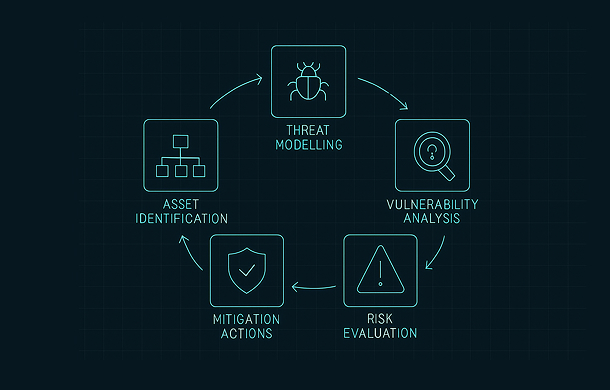
The CRA does not prescribe a specific methodology, but it requires manufacturers to follow a structured and documented approach. At minimum, every CRA risk assessment must include:
- Identification of intended use and reasonably foreseeable misuse.
- Identification of assets, attack surfaces and entry points.
- Threat modelling (e.g., STRIDE, LINDDUN, attack trees).
- Vulnerability analysis based on the product’s architecture.
- Risk evaluation using likelihood and impact criteria.
- Definition of risk-treatment actions and security measures.
- Traceability between risks and implemented mitigations.
This aligns with best practices from ISO/IEC 62443 and ISO/IEC 27005, both of which are referenced in EU cybersecurity guidance.
CRA Risk Assessment vs TARA, IEC 62443 and ISO/IEC 27005
The CRA tells you what the risk assessment must cover, not how to run it. That is good news if your team already uses an established methodology: you do not need to start over, you need to map your existing output to the regulation. This is how the common frameworks relate to the CRA deliverable:
| Framework | Origin | What it gives you | What is missing for the CRA |
|---|---|---|---|
| TARA (ISO/SAE 21434) | Automotive | Threat scenarios, attack feasibility, risk values | Mapping to Annex I requirements and Annex VII documentation structure |
| IEC 62443 | Industrial automation | Zones and conduits, security levels, detailed technical requirements | Regulatory framing: classification, support period, EU market obligations |
| ISO/IEC 27005 | Information security management | Asset-based risk identification and treatment process | Product focus: it targets organisations, not products with digital elements |
Whichever you use, the CRA output is the same: a documented register that identifies threats, rates likelihood and impact, defines mitigations, and traces each mitigation to the essential requirement it satisfies. The free template in this guide gives you that register structure directly, so any of these methodologies can feed it.
CRA Risk Assessment Framework: Step-by-Step
1. Define the Product and Its Operational Context
The Cyber Resilience Act risk assessment begins with a technical description of the product, including architecture, interfaces, data flows and connectivity. This establishes the baseline for identifying vulnerabilities and attack surfaces.
2. Identify Assets and Attack Surfaces
Common CRA-relevant assets include firmware, communication channels, authentication mechanisms, cryptographic operations and user data. Each asset must be mapped to potential attack paths.
3. Conduct Threat Modelling
Threat modelling methods such as STRIDE or attack trees help structure the analysis. The CRA does not require a specific model but expects a justified, repeatable approach.
4. Analyse Vulnerabilities
The CRA expects manufacturers to identify both known and potential vulnerabilities based on architecture, dependency chains and third-party components. This ties directly to SBOM requirements and open-source management.
5. Evaluate Likelihood and Impact
Risks must be evaluated using clear criteria. Impact should consider safety, data integrity, security degradation, service continuity and downstream consequences.
6. Define Mitigation Measures
Security measures must be proportional to the risks identified and aligned with Annex I requirements, including secure configuration, update mechanisms, vulnerability handling and cryptographic protections.
7. Document Traceability
Regulators expect a traceability matrix linking:
- Risk → Vulnerability → Mitigation → CRA requirement → Evidence
This is essential for audits and for the CRA technical documentation file.
Want this pre-built? Download the free template pack above and fill it as you go
Risk Assessment Examples for IoT, Embedded and Software Products
Example 1: IoT Sensor
- Threat: network interception
- Vulnerability: unencrypted communication
- Impact: confidentiality breach
- Mitigation: TLS 1.3 with certificate-based authentication
Here is what the register looks like in practice for a connected IoT sensor, using the 5×5 matrix from the template pack (likelihood x impact, 1 to 25):
| Threat | Likelihood (1-5) | Impact (1-5) | Risk | Mitigation | Annex I ref. |
|---|---|---|---|---|---|
| Default credentials allow unauthorised access | 4 | 5 | 20 (Critical) | Unique credentials per device, forced change on first use | I.5 |
| Unsigned firmware accepted during update | 2 | 5 | 10 (High) | Signed updates with signature verification and rollback | I.4, I.7 |
| Telemetry intercepted in transit | 3 | 4 | 12 (High) | TLS 1.3 on all connections, no plaintext fallback | I.6 |
| Denial of service on the radio interface | 3 | 3 | 9 (High) | Rate limiting, watchdog restart of essential functions | I.9 |
| Known vulnerability in a third-party library | 3 | 4 | 12 (High) | SBOM maintained, CVE monitoring, patch SLA | II.1, II.2 |
| Exposed debug port on the PCB | 2 | 4 | 8 (Medium) | Disable JTAG/UART in production units | I.11 |
Every row traces to the Annex I requirement it satisfies. That traceability column is what reviewers and market surveillance authorities look for first, and it is the difference between a security analysis and a CRA-compliant risk assessment.
Example 2: Embedded Controller
- Threat: local access exploitation
- Vulnerability: insecure debug interface
- Impact: unauthorised firmware modification
- Mitigation: secure boot, interface locking and debug authentication
Example 3: Software Application
- Threat: supply-chain compromise
- Vulnerability: outdated open-source package
- Impact: remote code execution
- Mitigation: SBOM tracking and automated dependency monitoring
How CRA Risk Assessment Influences Product Classification
The CRA risk assessment is the primary input for determining whether a product belongs to Default Class or Critical Class. Critical Class products must follow a more rigorous conformity assessment and involve a notified body.
Risk factors that increase the likelihood of Critical Class classification include:
- Connectivity to critical infrastructure
- Potential impact on safety or essential services
- High-value data processing
- Integration into industrial environments
Try our Scope Wizard
Full guide: CRA applicability & product classification

CRA Scope Wizard
Check if the Cyber Resilience Act applies to your product. Answer a few questions to determine CRA applicability and classification.
Documenting Your Cyber Resilience Act Risk Assessment
Under Annex II and Annex VII, manufacturers must include the Cyber Resilience Act risk assessment in their technical documentation. At minimum, documentation must cover:
- Risk assessment methodology
- Threat and asset identification
- Risk tables and evaluation
- Security controls and mitigations
- Traceability mapping
This documentation must remain available for 10 years after the product is placed on the market.
CRA Risk Assessment FAQ
Is a risk assessment mandatory under the Cyber Resilience Act?
Yes. Article 13(2) requires manufacturers to undertake an assessment of the cybersecurity risks associated with a product with digital elements, and to take its outcome into account during planning, design, development, production, delivery and maintenance. The assessment must be documented and included in the technical documentation described in Annex VII.
Which risk assessment methodology does the CRA require?
None. The regulation is deliberately methodology-neutral: it requires a documented, risk-based analysis but does not prescribe a framework. In practice, manufacturers use ISO/IEC 27005, IEC 62443 or TARA-style approaches and map the results to the essential requirements of Annex I. Our free template implements a simple 5×5 likelihood and impact method that fits this expectation.
What is the difference between TARA and a CRA risk assessment?
TARA (threat analysis and risk assessment) is a methodology, best known from ISO/SAE 21434 in automotive. The CRA risk assessment is a regulatory deliverable. If you already run TARA, its output feeds the CRA assessment directly; you mainly need to map each risk and mitigation to the relevant Annex I requirement and document it in the Annex VII structure.
How often must the CRA risk assessment be updated?
Article 13(3) requires updating it as appropriate during the support period, which is at least five years for most products. In practice: review it for every significant release, whenever a relevant vulnerability is discovered, and always after a substantial modification of the product.
Where does the risk assessment go in the technical documentation?
It is a dedicated section of the Annex VII technical file. It also drives other documents: the mitigations you select become evidence for the Annex I requirements checklist, and several user-facing outcomes appear in the Annex II information for users.
Do products already on the EU market need a CRA risk assessment?
Products placed on the market before 11 December 2027 only fall under the essential requirements once they undergo a substantial modification. The reporting obligations of Article 14, however, apply from 11 September 2026 to products on the market regardless of when they were placed.
Does the risk assessment determine my product’s classification?
Not directly. Classification (default, important Class I or II, critical) depends on whether the product matches a category in Annex III or Annex IV. The risk assessment supports and documents that determination, and for borderline products it provides the justification that market surveillance authorities will ask for.
Can one risk assessment cover several product variants?
Yes, when variants share the same design and the same CRA classification they can share one technical file, including the risk assessment. Genuinely different product types need separate assessments.
Conclusion
A CRA risk assessment is a mandatory, foundational activity for Cyber Resilience Act compliance. It shapes product classification, guides security design, informs technical documentation and ensures that products meet EU cybersecurity expectations. Organisations that begin the CRA risk assessment process early will reduce compliance risk, accelerate audits and improve the security quality of their digital products.
Download free CRA Risk Assessment
Template Pack
A practical worksheet set for structuring an initial cybersecurity risk assessment for a product with digital elements.
By submitting this form, you accept our Terms and acknowledge that Regulus will process your data to send the template. For more details, see our Privacy Policy.