Before a Product with Digital Elements (PDE) can be placed on the EU market under the Cyber Resilience Act (CRA), the manufacturer has to demonstrate that it meets the essential cybersecurity requirements in Annex I. Article 32 sets out the conformity assessment procedures available for doing so, and which of them you may use depends on how your product is classified.
This guide explains the four procedures (internal control, EU-type examination, full quality assurance and European cybersecurity certification), which classes can use each one, when a notified body has to be involved, and what documentation every route requires.
Free download: our CRA checklist, from scope to CE marking, in one PDF.
1. What Is a Conformity Assessment Under the CRA?
A conformity assessment is the process by which the manufacturer shows that both the product and its own processes meet Annex I: Part I covers the properties of the product, and Part II covers vulnerability handling. In practice, it rests on:
- The technical documentation described in Annex VII
- The cybersecurity risk assessment required by Article 13
- Evidence of secure design, development and production
- The vulnerability handling process, including the SBOM and the coordinated vulnerability disclosure policy
- The mechanism for distributing security updates
- Test reports showing that the requirements are met
Once conformity is demonstrated, the manufacturer draws up the EU declaration of conformity and affixes the CE marking. From 11 December 2027, when the CRA applies in full, a product in scope cannot be placed on the EU market without going through this process.
In Regulus, free for manufacturers: classify your product by its core function, with the exact Annex III or IV point.
2. The Four CRA Conformity Assessment Procedures
Article 32(1) and Annex VIII provide four routes:
- Internal control (module A): the manufacturer assesses conformity on its own responsibility, without a third party.
- EU-type examination (module B) followed by conformity to type based on internal production control (module C): a notified body examines the technical design, development and vulnerability handling processes and issues an EU-type examination certificate; the manufacturer then ensures production conforms to that type.
- Full quality assurance (module H): a notified body assesses and then monitors the manufacturer’s quality system for design, development, testing and vulnerability handling.
- A European cybersecurity certification scheme, where one is available and applicable under the Cybersecurity Act, Regulation (EU) 2019/881.
Which routes are open to you depends on your product classification: default, important Class I, important Class II (both in Annex III) or critical (Annex IV).
Generate the technical file and the declaration of conformity
Regulus builds the nine CRA documents in Word from what you know about your product, and marks what is still missing instead of inventing it. Free for manufacturers.
3. Internal Control (Module A): Who Can Use It
Under internal control, the manufacturer:
- Draws up the technical documentation described in Annex VII
- Ensures that design, development, production and vulnerability handling deliver compliance with Parts I and II of Annex I
- Draws up the EU declaration of conformity
- Affixes the CE marking without external review
Market surveillance authorities can ask for the documentation at any time.
3.1 Default products
Products that are not listed in Annex III or Annex IV can always use module A. This covers most products in scope, such as typical connected consumer devices, industrial equipment whose core function is not a listed one, and commercial software. A default product may also choose one of the other procedures voluntarily, but it is not required to.
3.2 Class I products, under one condition
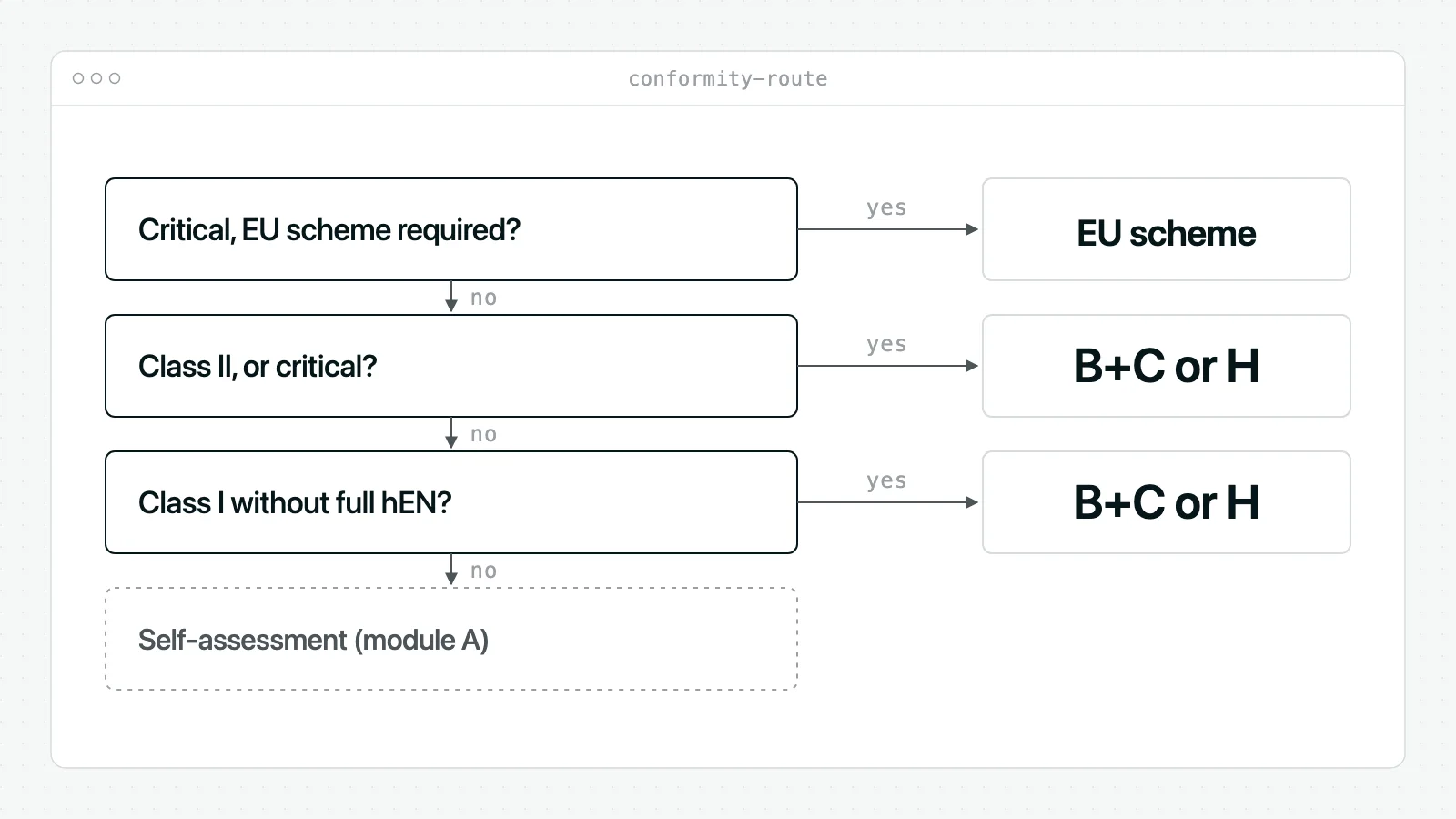
Important products in Class I (for example routers, operating systems, password managers, VPN products or smart home security products) can also use module A, but only if the manufacturer has applied in full harmonised standards, common specifications or a European cybersecurity certification scheme at assurance level at least “substantial”. If these have been applied only in part, or do not exist for the product, Article 32(2) requires modules B+C or module H, with a notified body.
There is one more exception: free and open-source software in Annex III can use module A, whatever its class, provided the technical documentation is made public when the product is placed on the market (Article 32(5)).
4. Third-Party Conformity Assessment: Class II, Critical and Some Class I
A notified body is involved in three situations:
- Class I products where harmonised standards, common specifications or a certification scheme have not been applied in full.
- Class II products (hypervisors and container runtime systems, firewalls and intrusion detection or prevention systems, tamper-resistant microprocessors and microcontrollers), always. They must use modules B+C, module H, or a European certification scheme at assurance level at least “substantial”. Self-assessment is not available.
- Critical products in Annex IV (hardware devices with security boxes, smart meter gateways, smartcards and secure elements). Where a delegated act under Article 8(1) requires it, they must obtain a European cybersecurity certificate at assurance level at least “substantial”. Where no such act applies, they follow the Class II procedures.
4.1 What the Notified Body Examines
Under module B, the notified body examines the technical documentation and supporting evidence, together with specimens of one or more critical parts of the product, and assesses the manufacturer’s vulnerability handling processes. Under module H, it assesses the quality system covering design, development, final inspection and testing, and vulnerability handling, and then carries out surveillance to check that the system is maintained throughout the support period. In both cases it may ask for further evidence or tests.
4.2 When Notified Bodies Are Available
The CRA’s provisions on notification of conformity assessment bodies (Chapter IV) have applied since 11 June 2026, so that bodies can be designated before the Regulation applies in full on 11 December 2027. If your product needs a notified body, plan for it well ahead of that date.
5. Comparison: Conformity Routes by Product Class
| Class | Where listed | Available procedures | Notified body? |
|---|---|---|---|
| Default | Not in Annex III or IV | Module A (or, voluntarily, B+C, H or a certification scheme) | No |
| Important, Class I | Annex III | Module A if harmonised standards, common specifications or a certification scheme at “substantial” level are applied in full; otherwise B+C or H | Only without full application of those standards or schemes |
| Important, Class II | Annex III | B+C, H, or a European certification scheme at “substantial” level | Yes, or a certification scheme |
| Critical | Annex IV | European cybersecurity certificate at “substantial” level or higher where a delegated act requires it; otherwise as Class II | Yes, or a certification scheme |
6. Documentation Requirements for Conformity Assessment
Whatever the route, the manufacturer draws up the technical documentation before placing the product on the market. Annex VII sets out what it must contain at a minimum:
- A general description of the product, its intended purpose and the software versions relevant to compliance, plus the user information required by Annex II
- The design, development and production of the product, including the system architecture
- The vulnerability handling processes, including the SBOM, the coordinated vulnerability disclosure policy, the contact address for reporting vulnerabilities and the solution for distributing updates securely
- The cybersecurity risk assessment under Article 13, showing how the requirements in Part I of Annex I apply
- The information used to determine the support period
- The harmonised standards, common specifications or certification schemes applied, or the solutions adopted where none were applied
- Test reports and a copy of the EU declaration of conformity
The EU declaration of conformity follows the model structure in Annex V: identification of the product, name and address of the manufacturer, references to the standards or certifications used and, where applicable, the notified body, the procedure performed and the certificate issued. It must be available in the languages required by each Member State where the product is sold.
The technical documentation is kept up to date at least during the support period. Together with the declaration of conformity, it must be kept at the disposal of market surveillance authorities for at least 10 years after the product is placed on the market, or for the support period if that is longer.
7. Key Steps of the Conformity Assessment Process
- Classify the product: default, Class I, Class II or critical, based on its core functionality
- Choose the conformity route allowed for that class
- Carry out the cybersecurity risk assessment
- Prepare the Annex VII technical documentation
- Test and validate against Annex I, Parts I and II
- Involve a notified body or certification scheme where the route requires it
- Draw up the EU declaration of conformity (Annex V) and affix the CE marking
- Keep the documentation up to date and available for 10 years or the support period, whichever is longer
8. Common Mistakes to Avoid
- Assuming every important product needs a notified body (Class I can self-assess if standards are applied in full)
- Assuming Class I can always self-assess (not without full application of harmonised standards, common specifications or a scheme)
- Classifying by components instead of core functionality, or treating any industrial or IoT product as Class II or critical
- Incomplete SBOM or missing evidence of vulnerability handling
- Not documenting tests or the reasoning behind the support period
- Missing or outdated risk assessment
9. How Regulus Helps Manufacturers
Regulus is a free platform for manufacturers that helps you prepare for conformity assessment:
- Classification of each product as default, Class I, Class II or critical, with the Annex III or IV reference
- A walk-through of the Annex I requirements
- The cybersecurity risk assessment
- SBOM import and vulnerability tracking, with the Article 14 reporting deadlines
- The nine CRA documents in Word, including the technical documentation and the EU declaration of conformity
An expert review is available as a paid option. Regulus does not certify products and is not a notified body. Start by evaluating your product: CRA Applicability Checker
Conclusion
The conformity route follows from the classification. Default products self-assess under module A. Class I products can do the same only by applying harmonised standards, common specifications or a certification scheme in full. Class II products always need a notified body or a certification scheme, and critical products need European certification where a delegated act requires it, or the Class II procedures otherwise. Whatever the route, the Annex VII documentation and the work behind it are the same, so starting early pays off.
For templates and guidance, visit our CRA Resources.
Classification by product type
How the official technical descriptions apply to specific products. All of them are in the classification guide by product type.
- Is a Connected Toy Class I or Default Under the CRA?
- Are Firewalls Class II Under the CRA? Firewalls, IDS, IPS and WAFs
- Is an IoT Gateway Class I, Class II or Default Under the CRA?
- Is a Microcontroller Class I, II or Critical Under the CRA?
- Is a PLC Class II Under the CRA? PLCs, SCADA and HMIs
- Are Routers Class I Under the CRA? Routers, Modems and Switches
- Are VPNs, Antivirus and Operating Systems Class I Under the CRA?
- Are Smart Locks and Security Cameras Class I Under the CRA?
- Are Smart Meter Gateways Critical Products Under the CRA?
- Are Smartwatches and Wearables Class I Under the CRA?